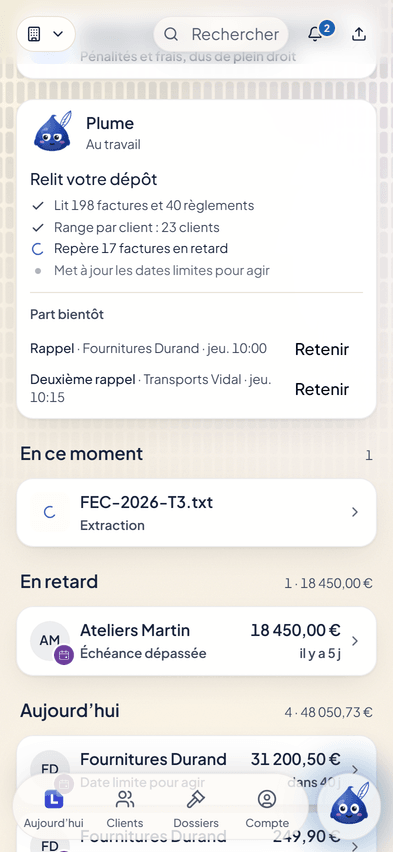
Reminders in your nameReminders and the formal letter go out in your name, and each one can be held back beforehand.
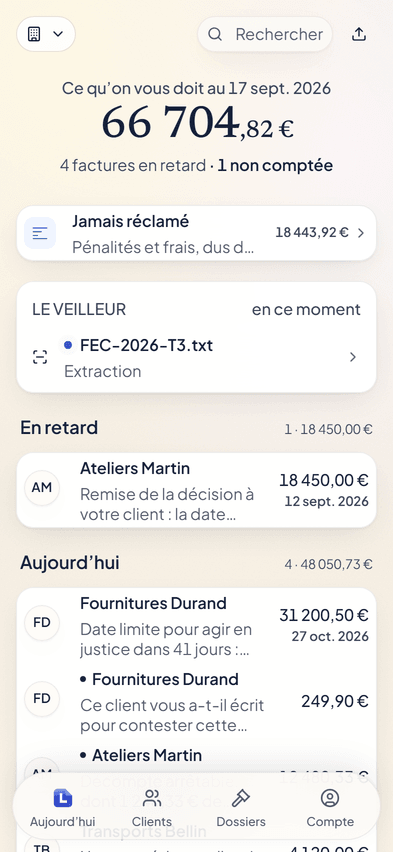
Penalties to the centThe penalties and costs due on each invoice, detailed period by period.
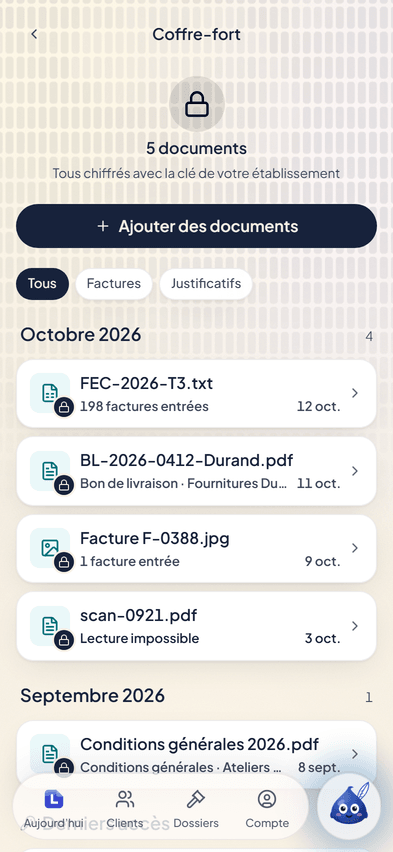
The vaultEvery document is sealed on arrival, and every opening is logged.
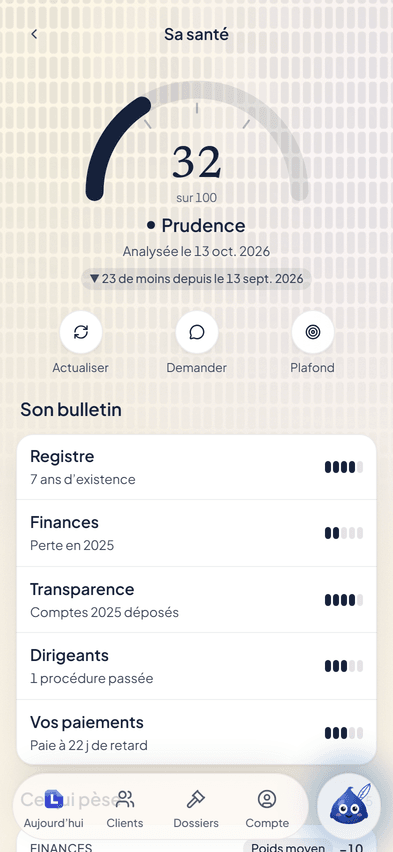
The health of your clientsA score out of one hundred, and each of the facts that move it, at its source.
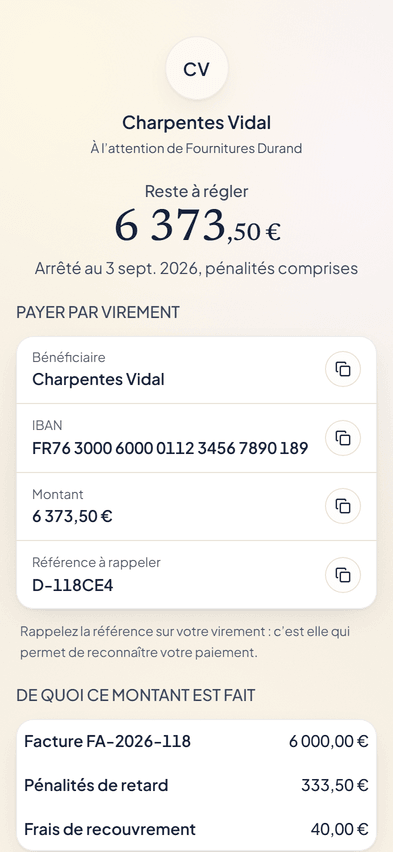
The payment pageYour client pays by bank transfer, into your account, from a page in your name.
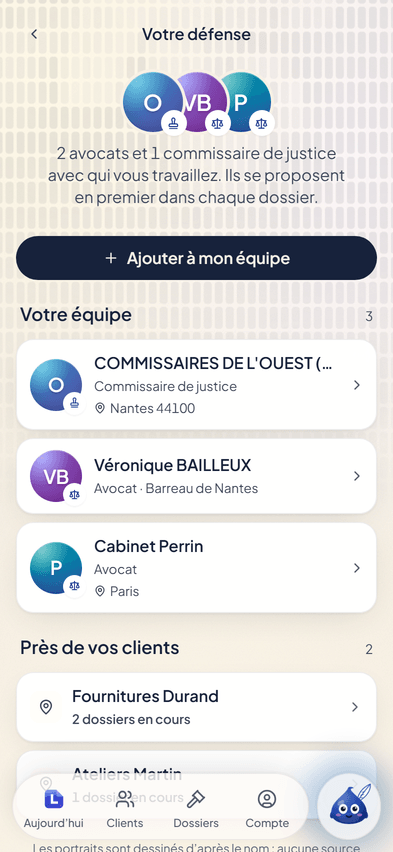
Your defenceThe lawyers and bailiffs (commissaires de justice) practising near your client, their contact details, and the case file ready to hand over to them.
Upload an export or connect your software: you see what you are owed within minutes. 30-day trial, €0 today, no commitment.
Many managers put off sending a reminder. They worry about seeming pushy, upsetting a loyal client, or simply getting it wrong. Meanwhile the invoice ages, and the reminder they eventually send is curter than it would have been.
There is another way: remind early, often, and always politely. Here is how to organise it.
Why your client has not (yet) paid
Before writing, it is worth asking what is holding things up. In the vast majority of cases, it is neither bad faith nor a dispute.
The invoice never arrived, or it is sitting in a shared inbox.
Your client is missing a document: a purchase order number, a delivery acceptance report, the correct billing address.
The invoice is waiting for internal approval from someone who is on leave.
Cash flow is tight, and your client pays those who chase first.
There is a disagreement they have not voiced: work they consider incomplete, a price they dispute.
Each cause calls for a different response. A lost invoice is sent again; a disagreement is discussed. The first reminder is mostly there to find out which case you are in.
An approach that works
Here is a common approach, to be adapted to your clients. The idea is simple: each step goes up a notch, and none of them takes your client by surprise.
1
A reminder before the due datea few days before
A short message, the invoice attached, and the payment details. This is not a chaser: it is a
courtesy to a client who wants to pay on time.
2
A note of the delay the next daythe day after the due date
The delay is noted, without blame. You simply ask whether the invoice was received, and whether
anything is missing to settle it.
3
A phone callone to two weeks later
A voice settles in two minutes what three emails have not. This is often where you learn the
real reason for the delay.
4
A letter that sums everything upif nothing has moved
A properly drafted reminder letter, setting out the invoices, the amounts, the penalties and
the costs, and setting a payment date.
What to write
A good reminder takes a few lines and answers the questions your client would ask: which invoice, how much, since when, and how to pay. Here is an example of a first message, to adapt in your own words.
Dear Ms Martin, unless we have made an error, invoice FA-2026-0118 of 1 March, for €12,400,
was payable on 31 March. Could you let me know whether it reached you, and whether you are
missing anything to settle it? Our bank details are below.
Have a good day.
What makes it effective:
One invoice, one amount. Your client has nothing to look up.
An open question. It leaves room for an explanation, rather than a defence.
The means to pay, straight away. Every obstacle removed, however small, brings payment closer.
Mentioning penalties without threatening
Late payment penalties and recovery costs are due in any case, without any reminder being needed (article L441-10 II du code de commerce). Mentioning them is therefore not a threat: it is information.
Tone makes all the difference. ‘In accordance with our terms and conditions, late payment penalties have applied since 1 April’ informs. ‘Failing payment within eight days, we will be obliged to…’ antagonises. In early reminders, many managers choose not to claim them, and keep them in reserve in case the situation drags on. That is a commercial choice, and it is yours to make.
When friendly reminders have produced nothing, a more formal letter is often sent: the formal notice (mise en demeure). The law does not impose any list of mandatory contents; it requires a ‘sufficient summons’ (article 1344 du code civil), that is, a clear request for payment that your client cannot misunderstand.
In practice, a good letter of this kind includes:
the list of invoices concerned, with their date and amount;
the penalties and recovery costs, itemised;
the total to be paid, and the date by which you expect it;
your bank details.
One important point: this letter, even when sent by registered post, does not stop the deadline for taking legal action (Cour de cassation, chambre commerciale, 18 mai 2022, n° 20-23.204 [publié]). We explain this in our article on the deadline.
When your client offers to pay in instalments
This is common, and often good news: your client acknowledges owing the sum and is looking for a solution. You may accept, or refuse: the law allows you to refuse a partial payment, even if what you supplied can be divided (article 1342-4 du code civil).
If you accept, it is better to put it in writing: a dated schedule, amount by amount. And bear in mind that each payment is applied first to the penalties, then to the invoice, as explained in our article on partial payments.
When a reminder is no longer enough
Sometimes nothing moves. Other routes then exist, before a judge or through a court bailiff (commissaire de justice). Whether or not to take them is a decision that is yours to make, and it should be prepared with a lawyer or a court bailiff, who can tell you what is possible in your case.
What you can do on your side is arrive at that meeting with a complete file: the invoices, the correspondence, the reminders and an itemised statement of what is owed.
What Letikette does
Letikette prepares each reminder in your name, with the right invoices, the right amounts and the penalties calculated. Nothing is sent without your approval. Your client receives a page in your name to pay by bank transfer, directly into your account.
The payment page your client receives: your name, the amount, and your bank details to copy.
This article presents common practices and general rules. It does not constitute legal advice: the decision to take action, and how to do so, remain yours.