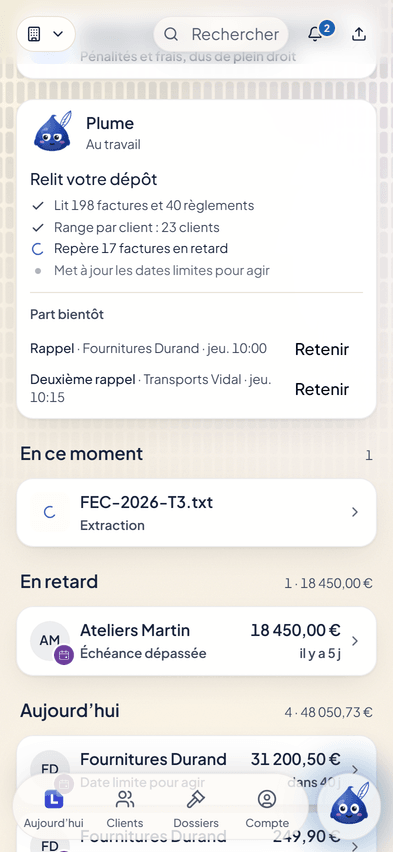
Reminders in your nameReminders and the formal letter go out in your name, and each one can be held back beforehand.
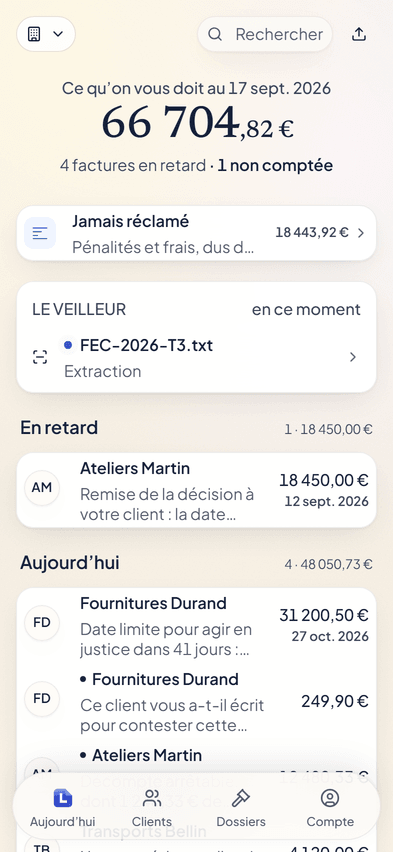
Penalties to the centThe penalties and costs due on each invoice, detailed period by period.
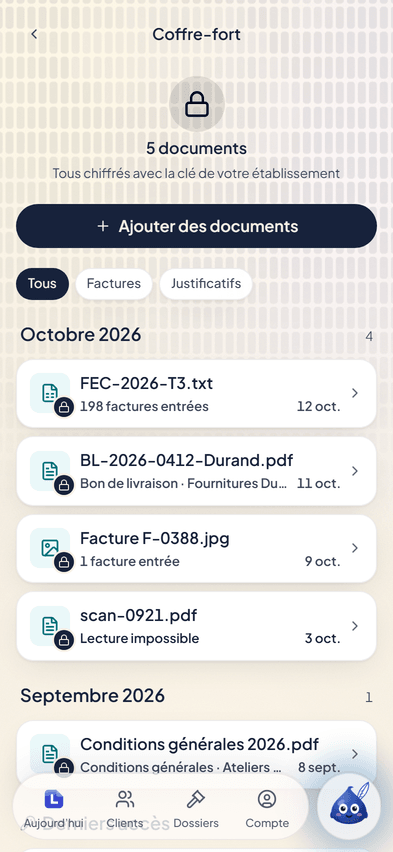
The vaultEvery document is sealed on arrival, and every opening is logged.
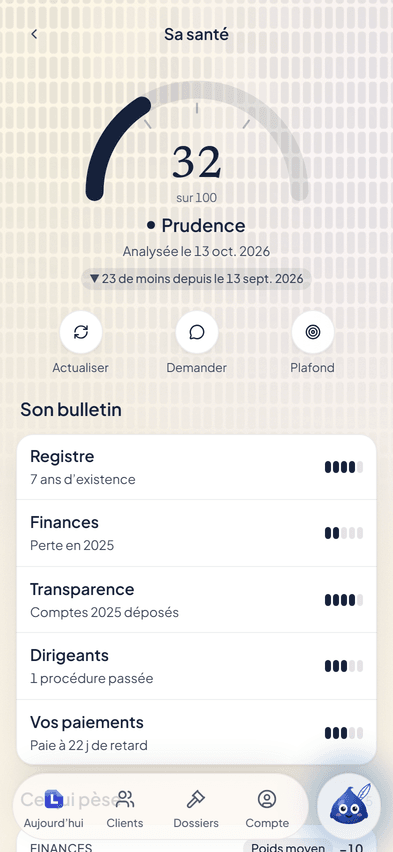
The health of your clientsA score out of one hundred, and each of the facts that move it, at its source.
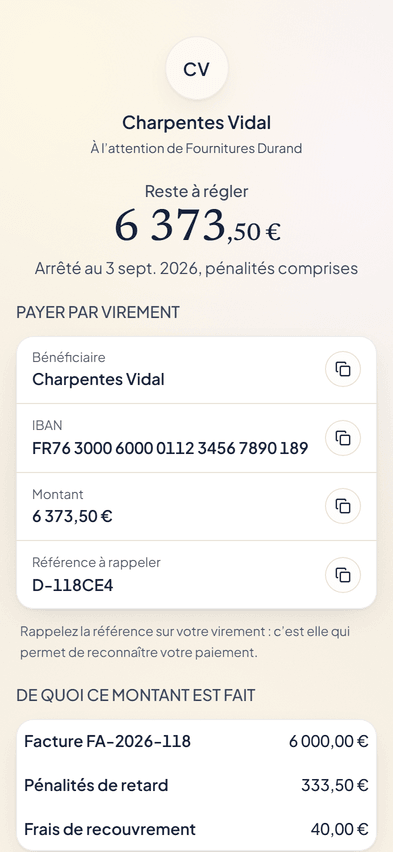
The payment pageYour client pays by bank transfer, into your account, from a page in your name.
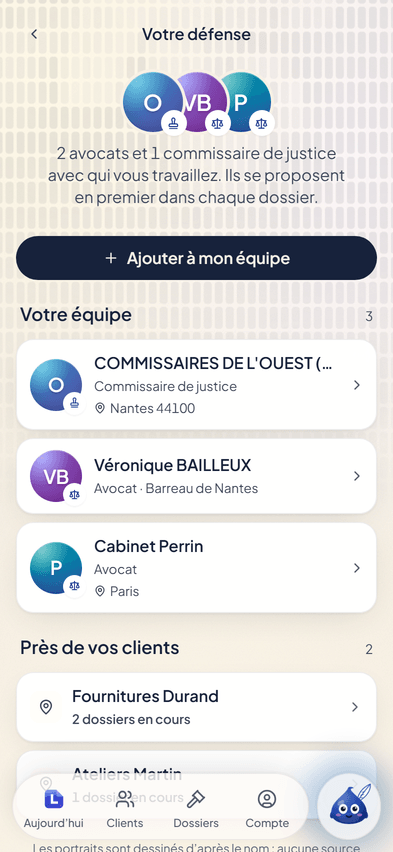
Your defenceThe lawyers and bailiffs (commissaires de justice) practising near your client, their contact details, and the case file ready to hand over to them.
Upload an export or connect your software: you see what you are owed within minutes. 30-day trial, €0 today, no commitment.
Your freight forwarder or charterer instructed you to carry goods. The goods have been delivered and the consignment note signed, but the party that instructed you has not paid. It no longer replies, or it is in difficulty. Most carriers think they have only one possible debtor: the party that entrusted the carriage to them. The law gives them others.
The consignment note, a contract between several parties
The French Commercial Code sets this out in a single sentence: ‘the consignment note forms a contract between the consignor, the carrier and the consignee, or between the consignor, the consignee, the freight forwarder and the carrier’ (article L132-8 du code de commerce). The code uses the old French term ‘voiturier’ for the carrier.
In other words, by signing the consignment note, the consignor and the consignee become parties to the contract of carriage, even though they did not order the carriage themselves.
A direct action for the price of carriage
The text draws the consequence: the carrier ‘has a direct claim for payment of its services against the consignor and the consignee’. Both are therefore liable for payment of the carriage price, alongside the party that instructed you.
Take an example carrier, subcontracted by a freight forwarder for a delivery round of building materials. The freight forwarder, having been paid by its own customer, does not settle the €3,600 invoice. The carrier can ask for payment from the consignor, the merchant who handed over the goods, or from the consignee, the site where they were delivered.
For the consignor, this comes as a real surprise: it may already have paid the freight forwarder. The text, however, makes no exception for this case.
A clause cannot set it aside
Some freight forwarding contracts, or consignors’ general terms, provide that the carrier may only turn to the freight forwarder. Such clauses have no effect: the text states that ‘any clause to the contrary is deemed unwritten’.
The Court of Cassation has also applied this provision to an international carriage governed by the Geneva Convention, on a point that the convention does not settle (commercial chamber, 25 November 2020, no. 18-25.768).
The time limit, however, does not change
The direct claim does not give you more time. It arises from the contract of carriage, and so follows its time limit for taking legal action: 1 an, counted from the handover of the goods to the consignee (article L133-6 du code de commerce). We explain this time limit in our dedicated article.
To exercise this right, you therefore need to keep three things: the signed consignment note, which identifies the consignor and the consignee; the proof of delivery with its date; and the unpaid invoice.
Before approaching them
The consignor and the consignee are customers of the party that instructed you, and sometimes potential customers of yours. Writing to them is a step to weigh up, and the decision is yours. It is easier with a well-ordered file: the amount due, the penalties attached to it, and the deadline to act.
What Letikette does
Letikette keeps this file for you: it calculates what you are owed on each carriage, including penalties and fees, monitors the deadline to act and prepares your letters in your name. If you have a lawyer, the file goes to them.
This article presents general rules. It is not legal advice: the decision to act, and how to do so, remain yours.