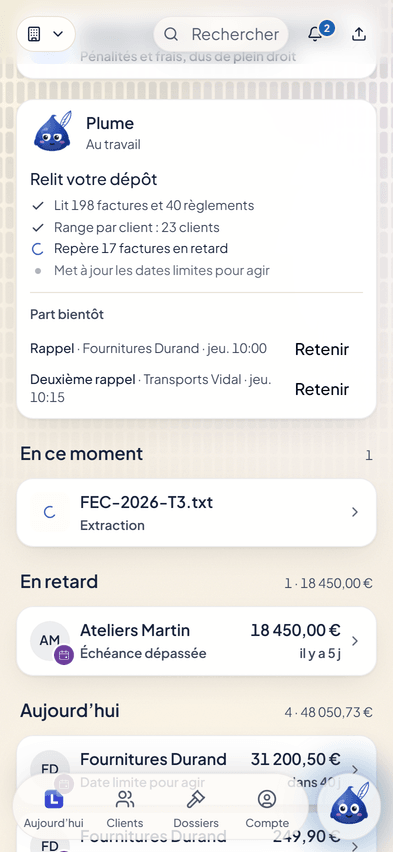
Reminders in your nameReminders and the formal letter go out in your name, and each one can be held back beforehand.
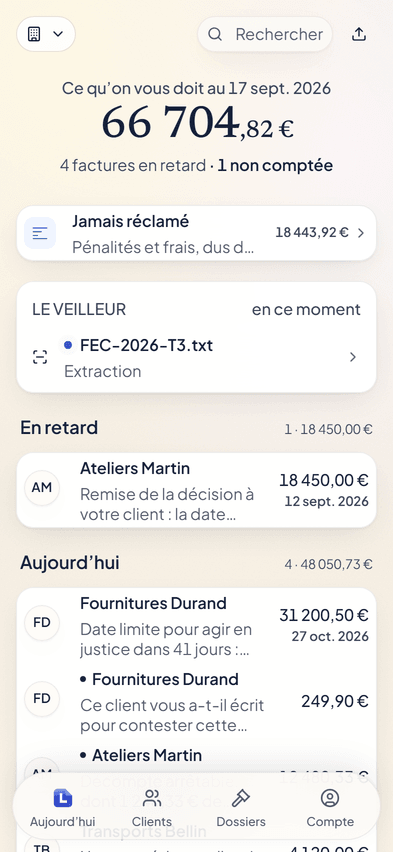
Penalties to the centThe penalties and costs due on each invoice, detailed period by period.
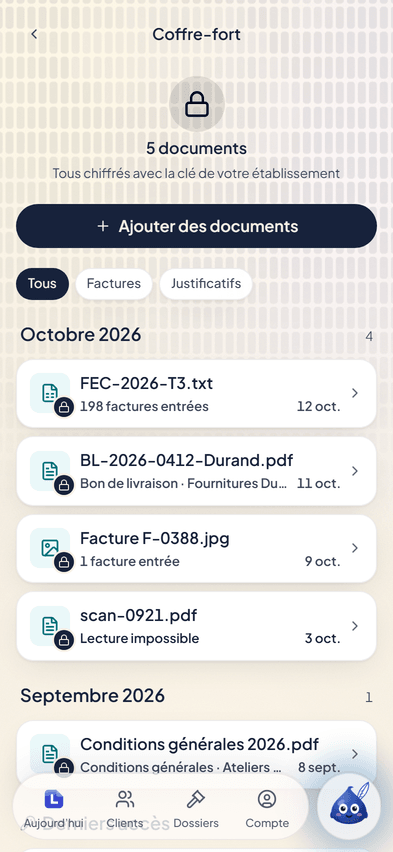
The vaultEvery document is sealed on arrival, and every opening is logged.
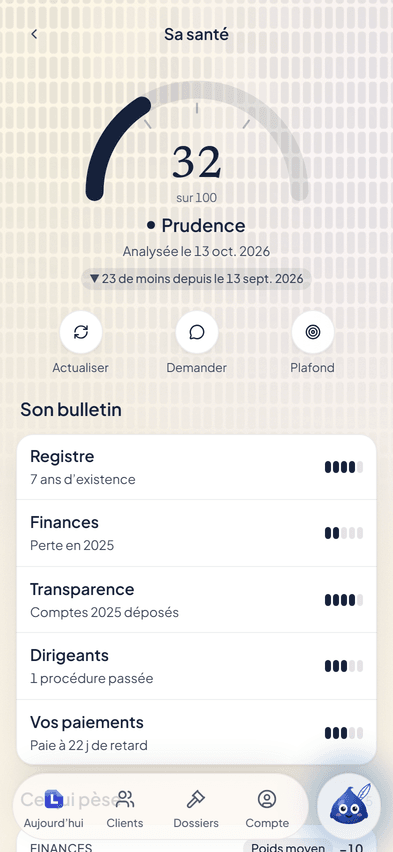
The health of your clientsA score out of one hundred, and each of the facts that move it, at its source.
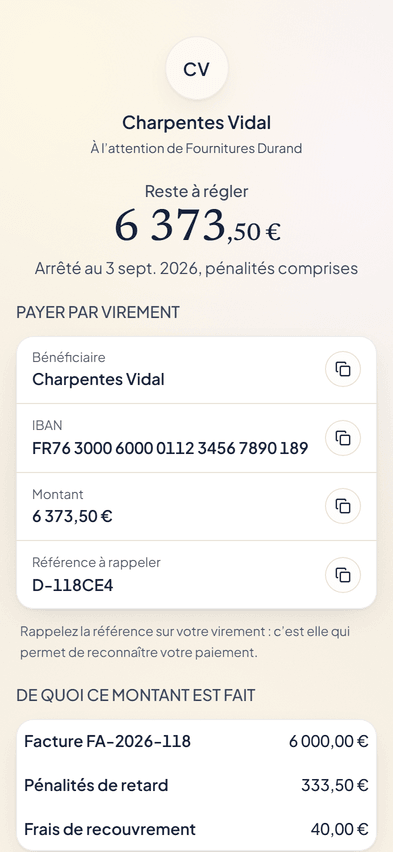
The payment pageYour client pays by bank transfer, into your account, from a page in your name.
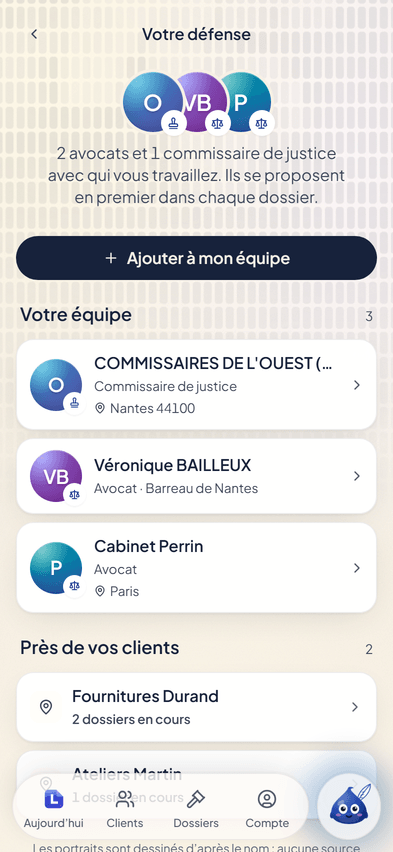
Your defenceThe lawyers and bailiffs (commissaires de justice) practising near your client, their contact details, and the case file ready to hand over to them.
Upload an export or connect your software: you see what you are owed within minutes. 30-day trial, €0 today, no commitment.
Un client en difficulté ne vous écrit pas pour vous prévenir. Il continue de commander, il répond un peu moins vite, il paie un peu plus tard. Le jour où vous l'apprenez, par un courrier du mandataire ou une annonce au registre, une partie de ce qu'il vous doit est déjà difficile à récupérer.
La bonne nouvelle : les signaux existent, et la plupart sont déjà dans vos chiffres.
I must output the English translation only. Here it is:
A struggling customer does not write to warn you. They keep ordering, they reply a little more slowly, they pay a little later. By the time you find out, through a letter from the insolvency practitioner or a notice in the register, part of what they owe you is already hard to recover.
The good news: the signals exist, and most of them are already in your figures.
Signs in your own invoices
You are often the first to notice that a customer's behaviour is changing, because you see their payments. None of these signals proves anything on its own. Several at once deserve your attention.
Signal
What it may indicate
They pay later than usual
Tighter cash flow
They pay part of an invoice, without warning
They are paying what they can, as they go
They ask for extra time, more and more often
A gap that is not closing
They dispute an old invoice, after the due date
A way of buying time
Your contact stops replying, or changes
A reorganisation, or a departure
A transfer or direct debit is rejected
An overdrawn account
They order more while paying more slowly
They are financing themselves through suppliers
The important word is ‘may’. A customer who disputes an invoice may be right, and a contact may simply be on holiday.
A broken habit says more than a delay
Late payments are often monitored with a fixed threshold: ‘beyond sixty days late, I start to worry’. That threshold treats two opposite situations in the same way.
The first customer has always paid sixty-five days after the due date, for years. That is their rhythm. Your alert goes off for every invoice, and eventually you stop looking at it.
The second customer has always paid eight days after the due date, and this invoice is now thirty-five days late. It stays below your threshold, so your alert stays silent. Yet it is the most telling change.
To measure this habit, use the median delay rather than the average: a single very late payment, linked to a dispute that has since been settled, should not distort everything else.
Public signs
When a company enters safeguard proceedings, judicial reorganisation or judicial liquidation, the judgment is published in the Bulletin officiel des annonces civiles et commerciales, the BODACC. Deregistrations are published there too.
This publication is more than information: it starts the clock for declaring your claim, 2 mois (article R622-24, alinéa 1, du code de commerce [R641-25 en liquidation]). What this declaration involves is explained in our article on judicial reorganisation.
What you can do without waiting
Spotting a signal does not oblige you to do anything. Here are the steps that business owners who have already experienced an unpaid invoice often take, to be chosen according to your relationship with the customer.
1
Add up the total
Add up everything this customer owes you, invoices past due and not yet due. That is what you are
really exposed to, and it is often more than the invoice that worries you.
2
Put your documents in order
Purchase orders, delivery notes, written exchanges: gather whatever supports each invoice while
everything is still easy to find.
3
Chase in writing
A courteous, dated written reminder keeps a record of what you asked for and when.
4
Adjust upcoming orders
A deposit, shorter payment terms, or delivery after payment: these are commercial choices, and
you set them for the future.
And if your customer offers to pay in instalments, a written agreement protects you better than a promise: see our article on the payment schedule.
What the signals do not tell you
A signal predicts nothing. It flags a change, which you are best placed to understand: a phone call is sometimes enough to learn that the accountant has changed, or that a large customer of your customer has itself paid late.
A signal is checked with the customer. It is not shared with other suppliers.
What Letikette does
Letikette measures, for each customer, the time in which they usually pay, based on their past payments: their record shows, for example, ‘pays in 45 days’. When an invoice departs clearly from that habit, the software states it, with figures, and says how many payments the habit is based on: ‘This customer usually pays 8 days after the due date, based on 12 observed payments. This invoice is at 35 days, which is 27 more than usual.’ It does not say that your customer is in trouble, and it does not tell you what to do.
Every night, it also picks up BODACC notices for your customers whose SIREN is known. When the SIREN is missing, the record says so plainly, ‘not monitored’, rather than letting you believe there is nothing in the register.
This article presents general guidelines. It does not constitute legal or financial advice: the decision to act, and how to do so, remain yours.