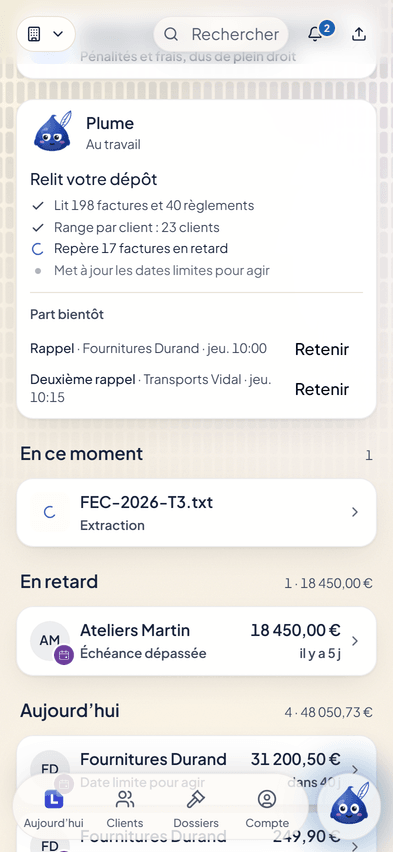
Reminders in your nameReminders and the formal letter go out in your name, and each one can be held back beforehand.
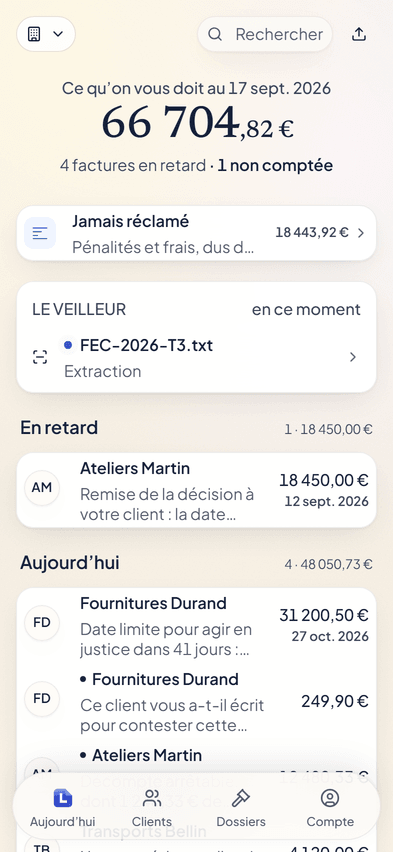
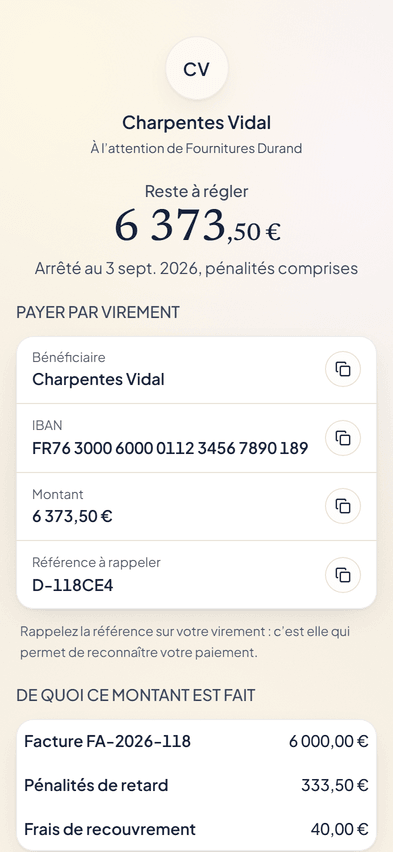
Penalties to the centThe penalties and costs due on each invoice, detailed period by period.
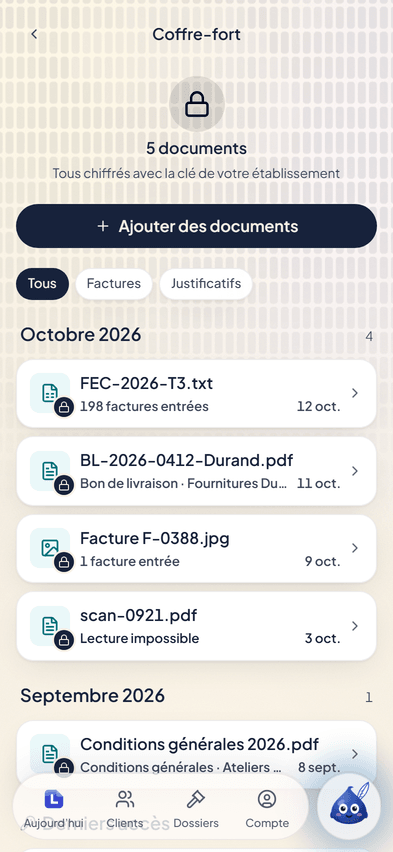
The vaultEvery document is sealed on arrival, and every opening is logged.
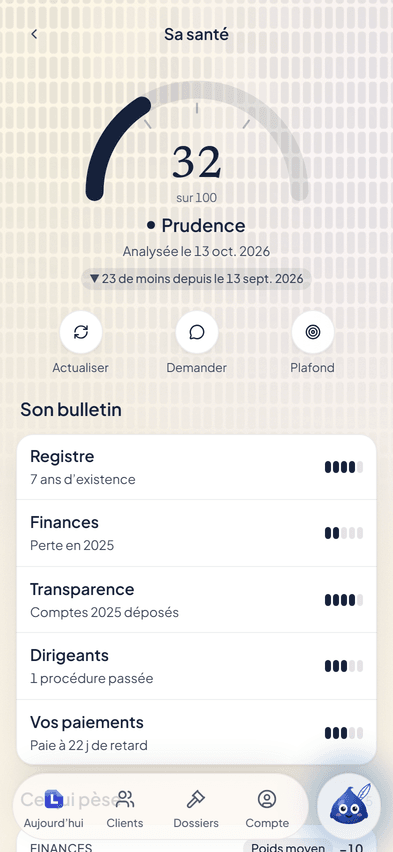
The health of your clientsA score out of one hundred, and each of the facts that move it, at its source.
The payment pageYour client pays by bank transfer, into your account, from a page in your name.
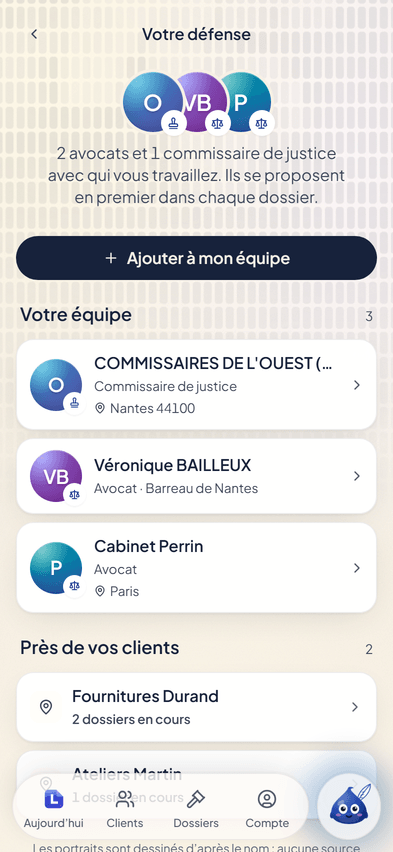
Your defenceThe lawyers and bailiffs (commissaires de justice) practising near your client, their contact details, and the case file ready to hand over to them.
Upload an export or connect your software: you see what you are owed within minutes. 30-day trial, €0 today, no commitment.
Late payment of an invoice costs more than cash flow. The law adds penalties, calculated day by day, that your client owes you even if you have not asked for them.
You still need to know how to calculate them. Three questions are enough: from which day, at what rate, and over how many days. Let's take them one by one, then work through a complete example.
What the law says, in one sentence
Between businesses, any invoice paid after its due date carries late-payment penalties. They are due ‘without any reminder being necessary’ (article L441-10 II du code de commerce).
In other words, you do not need to send a reminder for them to start accruing. The reminder is there to get you paid; it does not open any right you do not already have.
From which day
The penalties become payable ‘on the day following the payment date shown on the invoice’ (article L441-10 II du code de commerce).
If your invoice states payment by 31 March, the penalties run from 1 April. What counts is the date written on the invoice: not the day you notice the delay, nor the day of your first reminder.
At what rate
It all depends on what your general terms of sale say.
They set a rate. That rate applies, with one limit: it cannot be lower than three times the statutory interest rate (article L441-10 II du code de commerce). This half-year, the statutory interest rate between businesses is 2,75 %, which puts this floor at 8,25 %.
They say nothing. The rate is then the European Central Bank rate, plus dix points (article L441-10 II du code de commerce). This half-year, that comes to 12,40 % per year.
The European Central Bank rate changes. The reference rate is therefore set for each half-year, and an invoice that has been unpaid for nine months is calculated over two or three periods, each at its own rate. This is the most common source of error: applying today's rate to the whole delay.
A complete example
Take a sample joinery firm. It fitted the windows of an office building and invoiced the main contractor €12,400, payable by 31 March 2026. On 30 September, nothing has arrived. Here is what the invoice amounts to that day, as calculated by the Letikette engine.
An invoice of €12,400, due on 31 March 2026What it is worth on 30 September 2026, with no payment in the meantime.
Calculated by the Letikette engine, on a 365-day basis. Each line can be checked with a calculator: amount × rate × days ÷ 365. Days are counted from the due date included to the cut-off date excluded: the same total as from the day after the due date to the cut-off date included.
Three things to note.
Two penalty lines, not one. The delay spans 1 July: the first period is calculated at the first half-year rate, the second at the second half-year rate.
The formula never changes: amount due × rate × number of days ÷ 365. Your client can redo it on a calculator, which makes the amount hard to dispute.
Recovery costs are added, once per invoice: €40. They have their own rules, set out in our article on recovery costs.
When your client pays part
A partial payment does not reset the counter to zero. It is applied first to interest, and therefore to the penalties, then to the invoice amount (article 1343-1, alinéa 1, du code civil), unless your general terms provide for a different order. The penalties then continue to accrue on what remains due.
Example: on the invoice above, a payment of €3,000 first covers the penalties already accrued; only the remainder reduces the €12,400. The details are in our article on partial payments.
When your client is subject to insolvency proceedings
If your client is placed in safeguard proceedings, reorganisation or liquidation, the opening judgment ‘stops the running’ of late-payment interest (article L622-28, alinéa 1, du code de commerce [L641-3 en liquidation]). The penalties then stop accruing. As a precaution, Letikette stops the calculation the day before the judgment, because the legislation does not say whether the day itself counts.
What Letikette does
Letikette makes this calculation for each of your invoices, every day, at the rate of each half-year, and sets it out line by line as above. When you request it, the statement is dated that day and frozen: it is what you attach to a letter sent in your name.
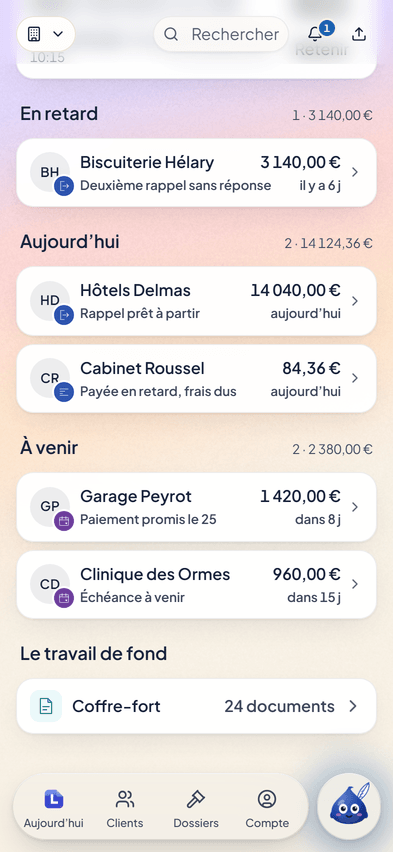
The Letikette Today screen for a services business: an invoice paid late, with its costs still due, next to what is going out that day.
This article presents general rules. It does not constitute legal advice: the decision to act, and how to do so, remain yours.