








Data Processing Agreement for Personal Data
Version 2.1: 5 November 2026 (reminders sent on behalf of the Controller, Articles 2 and 6 and Annex 2; Pappers, Articles 3 and 6; security measures in place, Annex 2). Version 2.0: 23 September 2026. Entered into pursuant to Article 28 of Regulation (EU) 2016/679. Annexed to the General Terms and Conditions, of which it forms an integral part.
Why this agreement exists
When a business entrusts its unpaid invoices to the Service, it transmits data whose purposes and means it determines: it is recovering its own receivables. Letikette merely processes that data on its behalf. The Customer is therefore the controller, and Letikette the processor.
Article 28(3) of the GDPR requires this relationship to be governed by a written contract with a specified content. Without one, both parties are in breach, and responsibility falls first on the controller.
And the characterisation is not open to debate, for a reason specific to this line of business. The people whose data the Service processes are not the Controller's customers: they are its debtors. A debtor trading as a sole trader (entrepreneur individuel) is identified by their surname and forenames; an invoice bears the name of a contact person, sometimes a direct telephone number; and the Service itself produces, on these people, a solvency status taken from the public register. This is personal data relating to third parties who asked for nothing, and it is precisely the situation that Article 28 exists to govern.
Article 1 — Parties and definitions
The Controller: the Customer, as defined in the General Terms and Conditions.
The Processor: Jules-Camille Doré, sole trader (entrepreneur individuel), trading under the business name Letikette.
The terms defined in Article 4 of the GDPR have the meaning given to them there.
Article 2 — Subject matter, duration, nature and purpose
Subject matter: the processing of data relating to the Controller's receivables and to their debtors, solely for the purpose of providing the Service.
Duration: that of the main contract, plus the thirty-day reversibility period.
Nature of the operations: collection, structuring, automated or native reading, matching, enrichment from public registers, calculation, storage, sending of emails on behalf of the Controller, return and erasure.
Purpose: to enable the Controller to track its unpaid invoices, monitor their due dates and limitation periods (prescription), calculate the amount due in a itemised manner, prepare the letters it sends to its debtors and, where it has enabled their sending, send them to the debtors by email on its behalf (Annex 2).
Article 3 — Categories of data and of data subjects
3.1 Debtors, who are the main category
Categories of data:
- name and business contact details of the debtor, including the personal name where the debtor trades in their own name;
- Trade and Companies Register (RCS) identification number, legal form, address;
- email address, where known;
- invoices, amounts, due dates, payments observed and usual payment period;
- financial health status taken from the public register and previously known status: two items of data that the Service itself produces on the data subject;
- court registry notices quoted word for word: nature of the judgment, date, court, link;
- where the Controller analyses the health of a debtor: its directors as published by the registers (name, capacity, date of taking up the post, companies directed and their insolvency proceedings (procédures collectives)), their date of birth being used only for this matching and not retained; no data relating to personal convictions, offences or sanctions;
- the name of a contact person, where applicable, as it appears on a submitted document.
Categories of data subjects: the Controller's debtors where they are natural persons, in particular sole traders (entrepreneurs individuels); the representatives and employees of debtors that are legal entities, identified on a document or by a named email address; and, where applicable, the Controller's employees identified on a document.
A particular feature to bear in mind. These people are not the Controller's customers in the contractual sense: they are its debtors. They have consented to nothing, are not informed by the Service, and have no access. It is for the Controller to inform them under Article 14 of the GDPR and to respond to their requests; the Processor assists it without taking its place.
3.2 The Controller's users
Name, email address, authentication credentials, and IP address recorded when a session is opened.
3.3 Special categories
No special category of data within the meaning of Article 9 of the GDPR is expected. The Controller undertakes not to transmit any. If it were nevertheless to transmit some, it would bear the consequences alone.
Article 4 — Obligations of the Processor
The Processor undertakes to:
4.1 Process on documented instructions. Process the data only on the documented instructions of the Controller, acceptance of the General Terms and Conditions and use of the Service constituting the initial instruction. If a legal obligation required additional processing, it would inform the Controller beforehand, unless prohibited by law.
4.2 Report an infringing instruction. Inform the Controller immediately if it considers that an instruction infringes the GDPR.
4.3 Preserve confidentiality. Authorise access only to persons bound by a duty of confidentiality, and only within the scope necessary.
4.4 Maintain security. Implement the technical and organisational measures described in Annex 2.
4.5 Assist the Controller, taking into account the nature of the processing and the information available to it:
- in responding to requests to exercise rights, by providing the means of extraction, rectification and erasure;
- in complying with the obligations relating to security, breach notification, impact assessment and prior consultation, provided for in Articles 32 to 36.
4.6 Notify breaches. Notify the Controller of any personal data breach within forty-eight hours of becoming aware of it, providing the information necessary for its own notification to the supervisory authority.
4.7 Return and erase. At the end of the contract, return the data in a structured format, then erase them and any existing copies under the conditions of Article 8.
4.8 Make available the information necessary to demonstrate compliance with Article 28 and to allow audits, under the conditions of Article 9.
4.9 Keep a record of the categories of processing carried out on behalf of the Controller, in accordance with Article 30(2).
Article 5 — Obligations of the Controller
The Controller undertakes to:
- transmit only data that it is entitled to process, and to have a legal basis for doing so;
- inform the data subjects of the use of the Processor, in particular its suppliers whose data appear on the invoices submitted;
- document in writing any instruction outside the normal use of the Service;
- oversee compliance with the obligations of Article 28 throughout the processing.
Article 6 — Sub-processing
The Controller authorises the Processor to use the following sub-processors, a general authorisation within the meaning of Article 28(2):
| Sub-processor | Service | Location | Transfer outside the EU |
|---|---|---|---|
| Convex, Inc. | Database, storage, execution | aws-us-east-1, United States |
Yes — see 7.2 |
| Vercel Inc. | Hosting of the application | cdg1, Paris |
No |
| Anthropic PBC | Reading of unstructured documents, assistant built into the Service | United States | Yes — see 7.1 |
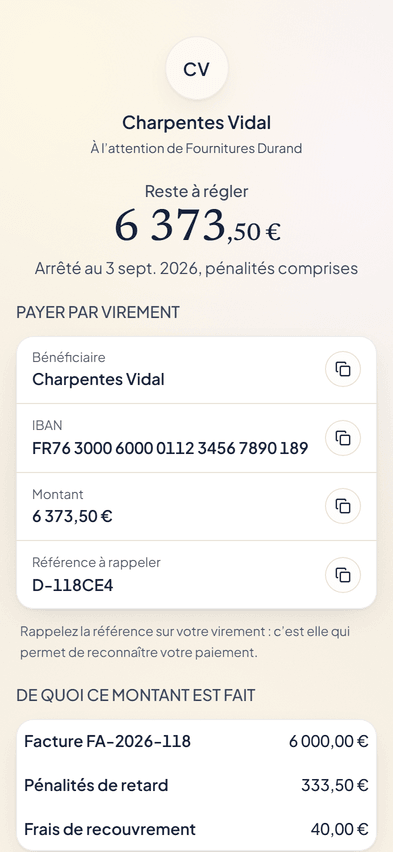
| Resend, Inc. | Delivery of service emails and of reminders sent on behalf of the Controller: recipient address and content of the email | United States | Yes, standard contractual clauses |
| Paddle.com Market Ltd | Billing | United Kingdom | Adequacy decision |
| Pappers | Reading of the public data of a company and its directors, for the analysis of its health (Article 3.1) | France | No |
| Opendatasoft / DILA | Publication of the BODACC, queried on request | France | No |
| Qonto | Accounting import, connected by the Controller | France | No |
Any change of sub-processor is notified to the Controller thirty days before it takes effect. The Controller may object within that period on legitimate and documented grounds; failing agreement, it may terminate without compensation.
The Processor imposes on each sub-processor the same obligations as those of this agreement and remains fully liable to the Controller for their performance.
Article 7 — Transfers outside the European Union
7.1 Anthropic PBC, United States
This transfer is structural and not incidental. When an unstructured document is submitted, the file is transmitted in its entirety to Anthropic's application programming interface for reading: it is sent as it is, without cropping or conversion into images.
Three processing operations use this route, and no others: the reading of a submitted document, the reading of a supporting document, and exchanges with the assistant built into the Service.
One exception, and it is significant. A structured electronic invoice (a PDF embedding a Factur-X, or an XML file in CII format) is read by the Processor on its own server. No data leaves, and the amounts are taken to the exact cent rather than interpreted. The share of documents concerned will grow as electronic invoicing becomes general.
It is governed by the standard contractual clauses adopted by the European Commission in its Implementing Decision (EU) 2021/914, supplemented by the data processing agreement concluded with Anthropic and by the supplementary measures that it provides for.
The retention period of the data transmitted and the conditions of their use are governed by that agreement.
7.2 Convex, Inc., United States — and it covers EVERYTHING
Noted on 23 September 2026: the production deployment is in the aws-us-east-1 region.
This transfer does not relate to one particular processing operation: it covers all the data
entrusted to the Processor. The database, the submitted files and the execution of functions are
located in the United States. The application that responds to requests is hosted in the cdg1
region in Paris; but the data that it reads and writes are not.
It is governed by the same standard contractual clauses as the transfer in Article 7.1.
This region is fixed when a deployment is created and cannot be changed: changing it would require a migration to a new deployment. Any such migration would be notified to the Controller under the conditions of Article 6.
Article 8 — Fate of the data at the end of the contract
For thirty days from the end of the contract, the Controller may export its Statements (Décomptes) and its data in tabular format.
Erasure is obtained on request, and it is then complete: deleting a workspace (établissement) erases all the data attached to it, storage files included, within a period corresponding to the backup purge cycles of the sub-processors.
Two limits are stated rather than concealed, because an agreement that promised an erasure not carried out would be a breach and not an imprecision:
- no automatic erasure is triggered at the end of the contract; it is obtained on request;
- erasure of individual items is not tooled: a request concerning a single debtor or a single invoice cannot, at present, receive any technical response other than deletion of the entire workspace. The Processor informs the Controller of this so that it can take it into account in its response to the data subject.
Excluded from erasure are only the data that the Processor is legally required to retain, in particular the accounting records relating to the subscription. These are then archived, with restricted access, for the legal period only.
A certificate of erasure is issued on request.
Article 9 — Audit
The Controller may, once a year and on thirty days' notice, request disclosure of the information demonstrating compliance with this agreement.
An on-site audit may be carried out in the event of an established data breach or a documented failure to comply, at the Controller's expense, by an independent auditor bound by confidentiality and who is not a competitor of the Processor.
Article 10 — Liability
Each party bears the consequences of its own breaches.
The limitations of liability in Article 11 of the General Terms and Conditions apply to this agreement, without prejudice to Article 82 of the GDPR, whose provisions cannot be set aside by contract.
Annex 1 — Summary description of the processing
| Nature | Reading, matching, enrichment from public registers, calculation, storage |
| Purpose | Tracking of unpaid invoices, monitoring of due dates and limitation periods (prescription), itemised calculation of what is owed |
| Duration | Duration of the contract, plus thirty days of reversibility |
| Type of data | See Article 3 |
| Data subjects | See Article 3 — mainly debtors, who are not the Controller's customers |
| Main location | United States (aws-us-east-1), see Article 7.2. The application is executed in France, the data are not |
Annex 2 — Technical and organisational measures
Within the meaning of Article 32 of the GDPR. Each is in place at the date of drafting; none is planned.
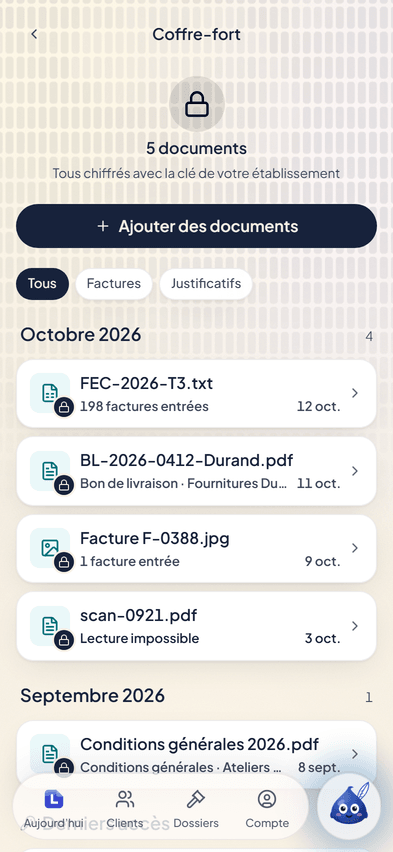
Encryption. Exchanges encrypted in transit, strict HTTPS with an HSTS header of two years' duration. Submitted documents encrypted at rest with AES-256-GCM from the moment they arrive, under a key specific to each workspace, itself encrypted by a master key kept outside the database; a document opens only through a single-use token valid for one minute. Access credentials given to connected software are encrypted in the database. Passwords are stored as hashes. The Processor holds the keys: this encryption protects the stored data, it does not place them beyond the Processor's reach.
Partitioning. Strict separation of data by workspace, applied to every server request and not at the level of the display. An automated test fails if a new table carrying a workspace identifier escapes the purge.
A single database is shared: the professional directory of court-appointed officers (auxiliaires de justice), compiled from public sources. It is fed by no customer data, and it does, however, contain personal data of natural persons — see section 8 of the privacy policy, where it is described as such rather than presented as anonymous.
Access control. Named accounts, no shared account. Every server request checks that the user belongs to the workspace before returning any data. Login attempts are limited; two-factor authentication is offered to all users and required of the Processor's team, which never sees the contents of a file. An invitation to join a workspace opens only with the address to which it was sent.
Payment links. The page where a debtor consults what they owe opens through a link that cannot be guessed. It stops responding as soon as the file is closed or its invoices are settled, and the Controller closes it with a single action.
The two roles are now enforced. Administrator and member exist in the data model, and the check is actually called on sensitive operations: workspace settings, billing, invitations, bank connections, erasure of data.
Until 23 September 2026 this measure carried the opposite warning: "no check applies them today; the function written for this purpose is called nowhere". It was accurate when written; the product has since corrected it. The warning is withdrawn because it has become false, and the fact is noted here so that the correction can be verified: a document that corrects itself only in the unfavourable direction inspires no more confidence than a document that never corrects itself.
Logging. The Service keeps, for each workspace, a security log (successful or refused logins with their IP address and device, two-factor authentication enabled or removed, software connected and disconnected), retained for thirteen months, and the log of each document (submission, opening, download, removal). Each opening of a workspace record by the Processor's team is logged. The execution platform also traces operations, for the period provided in its terms.
Auditability of the processing. Every amount claimed is itemised: a Statement (Décompte) carries its segments — which principal, which rate, over how many days, on which annual basis — so that a third party who disputes it can redo it by hand. Each legal value applied carries its source, its date of retrieval and the indication that it has not been validated by a lawyer. Every document that claims an amount dates it to the day on which it is prepared; that amount is no longer modified, and a new calculation produces a new Statement, dated in turn.
The register's finding is quoted verbatim. The nature of a judgment is copied as the register writes it, without rewording — rewording would amount to offering a legal reading of it.
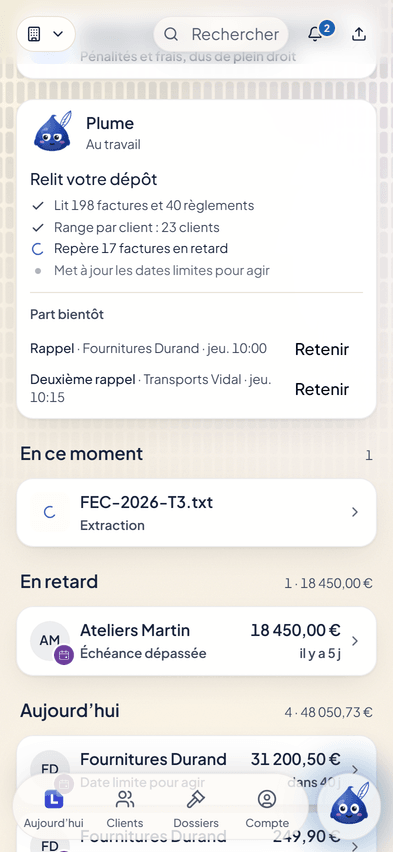
Nothing is sent without the Controller's decision. Reminders are sent automatically, by email and in its name, only after one of its administrators has enabled their sending having read what will be sent, and only on the files that it has started. Each one is displayed an hour before it is sent and can be held back with a single action; a payment received in the meantime stops it; the debtor's replies arrive at the Controller's address. No procedure is recommended, no document is addressed to a court, no undefined criterion is presumed to be met. The Service measures and records; the Controller decides.
Minimisation. No sensitive data is collected. The data processed on behalf of the Controller is used neither for audience measurement, nor for marketing, nor for profiling, nor for training an artificial intelligence model.
Management of secrets. Operating secrets are kept outside the code repository and injected at runtime, with automated checking of their presence before each deployment, and automatic scanning for secrets in the code history on each push.
Backups. Carried out by the database host, in accordance with its contractual commitments, with purging in accordance with Article 8.