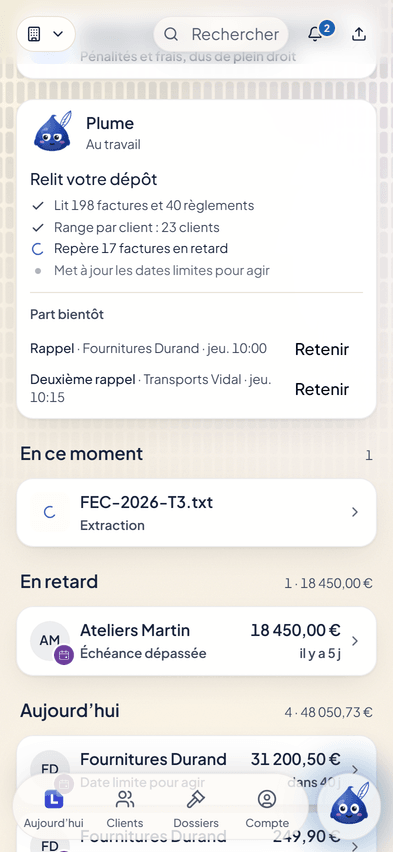
Reminders in your nameReminders and the formal letter go out in your name, and each one can be held back beforehand.
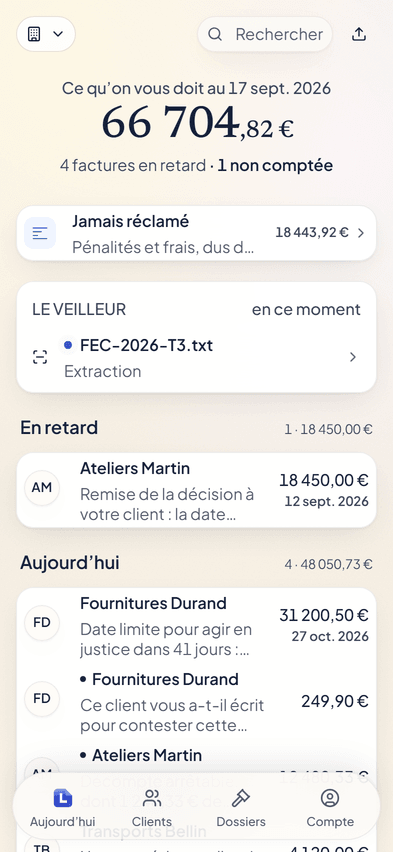
Penalties to the centThe penalties and costs due on each invoice, detailed period by period.
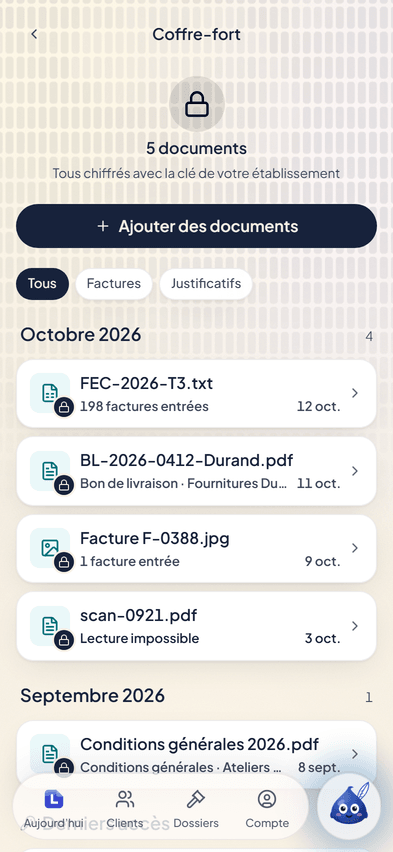
The vaultEvery document is sealed on arrival, and every opening is logged.
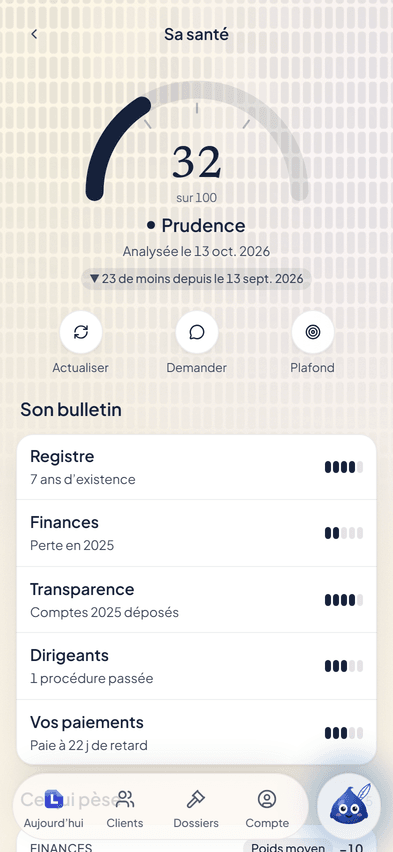
The health of your clientsA score out of one hundred, and each of the facts that move it, at its source.
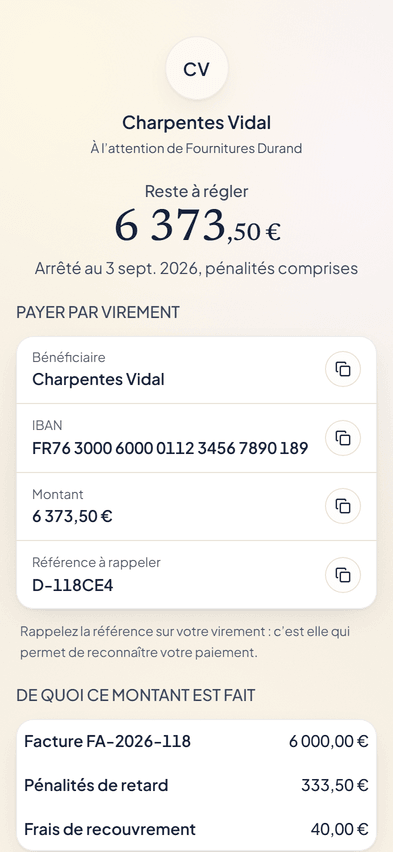
The payment pageYour client pays by bank transfer, into your account, from a page in your name.
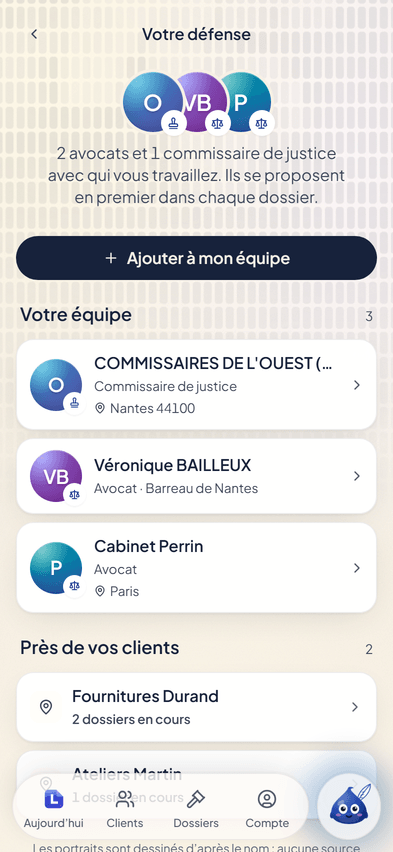
Your defenceThe lawyers and bailiffs (commissaires de justice) practising near your client, their contact details, and the case file ready to hand over to them.
Upload an export or connect your software: you see what you are owed within minutes. 30-day trial, €0 today, no commitment.
Un client qui paie une partie de ce qu'il doit, c'est une bonne nouvelle. →
A customer who pays part of what they owe is good news. But the question that follows is less simple than it seems: what does that payment go towards?
The answer determines the penalties that keep running, the invoice that stays open, and the total you will claim afterwards. The French Civil Code answers in three rules.
Accept or refuse
The first thing to know: you are not obliged to accept. ‘A creditor may refuse a partial payment even if the performance is divisible’ (article 1342-4 du code civil).
In practice, most managers accept: a payment, even an incomplete one, is better than nothing, and it shows that your customer is looking for a solution. It is a commercial choice. What follows only tells you what that payment covers once it has been accepted.
On a single invoice, penalties come first
‘A partial payment is applied first to interest’ (article 1343-1, alinéa 1, du code civil). Letikette applies this rule to late-payment penalties, which are interest due for the delay.
Take an example invoice of €10,000, on which €300 in penalties has built up. Your customer pays €3,000.
The €3,000 payment covers
Amount
What remains due
first the penalties
€300
€0 in penalties
then the invoice
€2,700
€7,300
Penalties then start again from zero and run on the remaining €7,300. If the payment had first reduced the invoice, €7,000 would remain due plus €300 in penalties: the same total on that day, but with future penalties calculated on a lower base.
This rule gives way to your contract: a clause in your terms and conditions that provides for a different order takes precedence.
Several invoices: which order
When your customer owes several invoices and pays a sum without saying which one it settles, the law sets an order (article 1342-10 du code civil). You follow it step by step, until the first step that settles the matter.
1
What your customer says
If they state which invoice they are paying, that invoice is the one paid.
2
Invoices past their due date
Otherwise, the payment goes first to invoices whose due date has passed, before those that are
not yet payable.
3
The one your customer had the most interest in paying
Among the overdue invoices, the law refers to the one they had ‘the most interest in discharging’.
No text says precisely what this means.
4
The oldest
Failing that, the oldest invoice is paid first.
5
Pro rata
If everything is equal, the payment is split between the invoices, in proportion to their amounts.
Example: your customer owes a January invoice and a February invoice, both past their due date, and an April invoice that is not yet due. They pay €2,000 without specifying anything. The April invoice is set aside, since it is not yet due. Between January and February, as there is no way to know which one they had the most interest in paying, Letikette suggests the oldest, January, and asks you to confirm.
A credit note is not a payment
Sometimes part of the sum is settled by a credit note: a goodwill gesture, goods taken back, or a billing error corrected. A credit note is not a payment: it reduces the price of the invoice.
The difference matters for the calculation. A partial payment covers the penalties first; a credit note, by contrast, directly reduces the amount of the invoice, and therefore the base on which the penalties are calculated.
What Letikette does
Letikette matches each payment to your invoices, applies it in the order set by law, and shows you when a choice is left to you. Penalties are then recalculated on what remains due, to the cent, and the detail of each allocation appears in the breakdown.
This article sets out general rules. It is not legal advice: the decision to take action, and how to do so, remain yours.