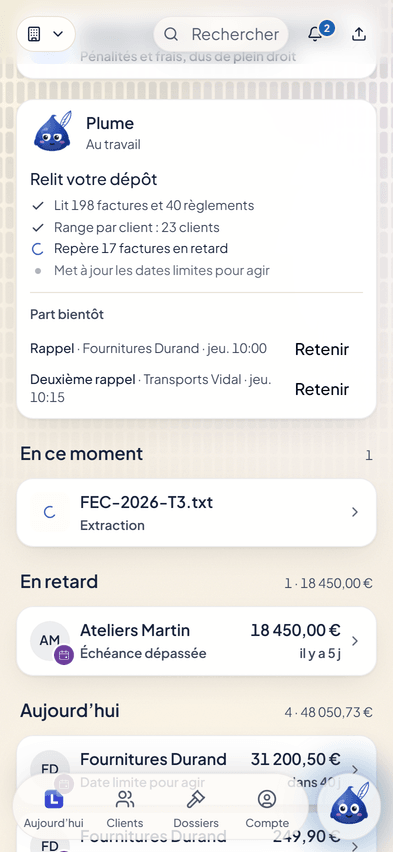
Reminders in your nameReminders and the formal letter go out in your name, and each one can be held back beforehand.
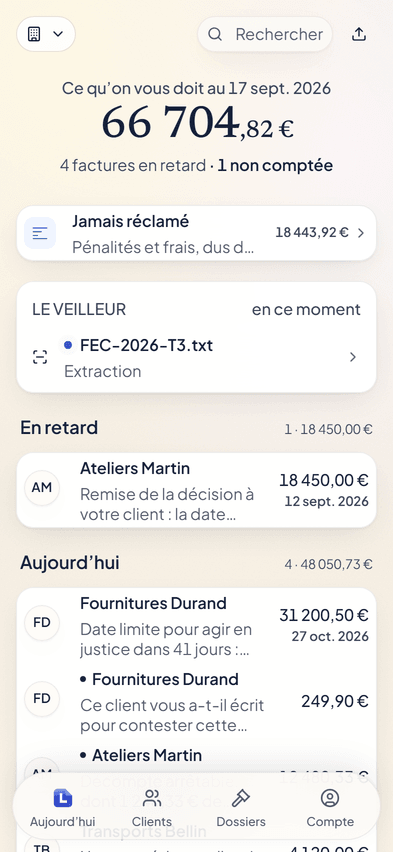
Penalties to the centThe penalties and costs due on each invoice, detailed period by period.
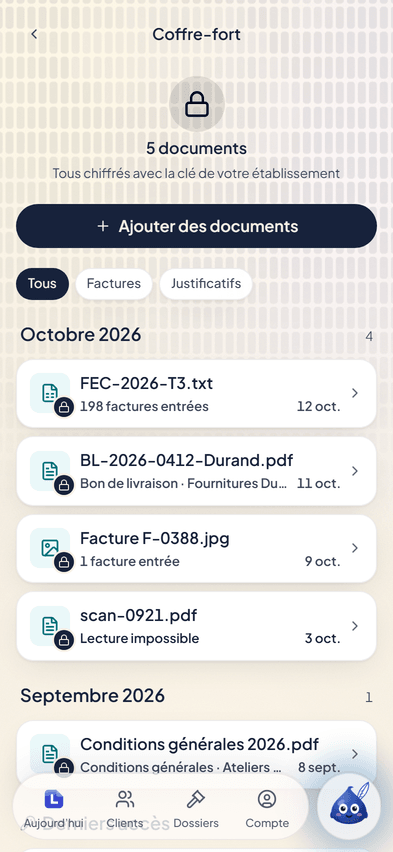
The vaultEvery document is sealed on arrival, and every opening is logged.
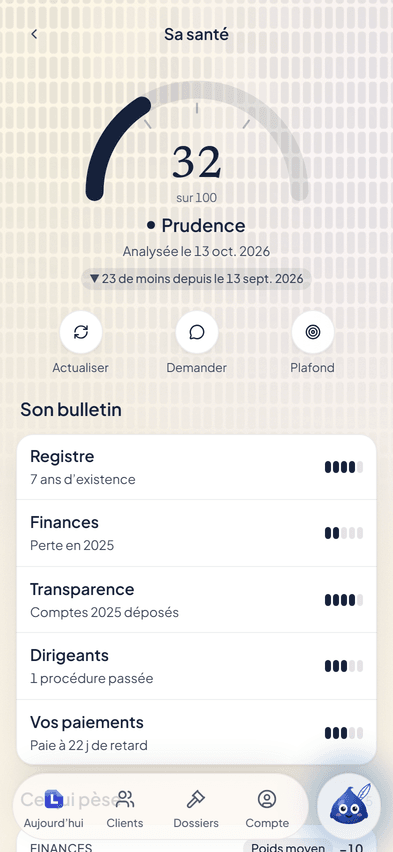
The health of your clientsA score out of one hundred, and each of the facts that move it, at its source.
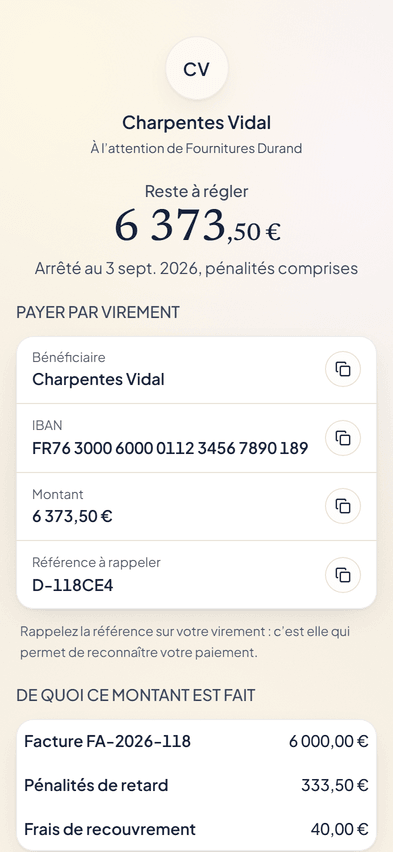
The payment pageYour client pays by bank transfer, into your account, from a page in your name.
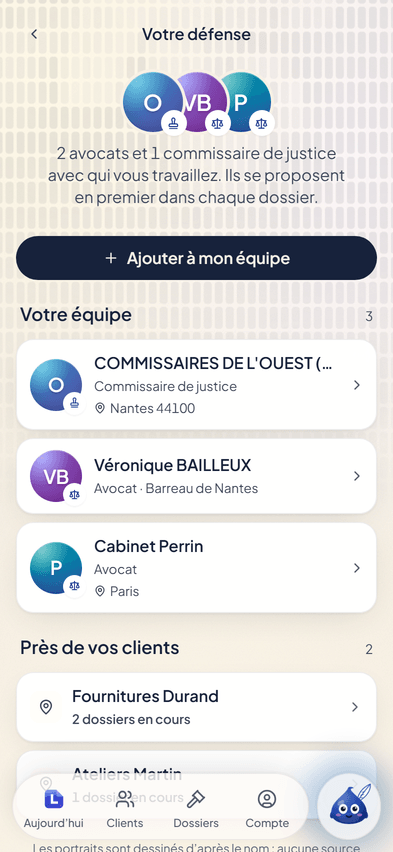
Your defenceThe lawyers and bailiffs (commissaires de justice) practising near your client, their contact details, and the case file ready to hand over to them.
Upload an export or connect your software: you see what you are owed within minutes. 30-day trial, €0 today, no commitment.
Tradespeople in the building trade often work for two kinds of client: businesses, such as a developer, a managing agent or a general contractor, and private individuals, for a renovation, a kitchen or an extension. On site, the difference is invisible. On an unpaid invoice, it changes everything.
The time limit for action by a private individual
An invoice addressed to a business can be claimed in court for 5 ans
(article L110-4 du code de commerce). An invoice addressed to a private individual can be claimed for only
2 ans. This is the rule for actions brought by a professional
for goods or services supplied to a consumer
(article L218-2 du code de la consommation).
Between businesses, in general5 ans
Sale to a private individual2 ans
Carriage of goods1 an
The time limit runs from its starting point, which differs depending on the case.
A period that cannot be extended
Under the general rules, the period runs from the supply of the service, that is, the completion of
the works. It is also not negotiable: the French Consumer Code prohibits changing its length,
even by agreement with the client.
Take, as an example, a renovation firm that finishes a bathroom for a private individual in the spring. The client disputes a finishing detail and withholds the balance. The discussions
drag on, and so do the reminders. If the time limit expires during these discussions, the invoice can no longer be claimed
before a court, and a reminder, even a formal one, does not interrupt it
(Cour de cassation, chambre commerciale, 18 mai 2022, n° 20-23.204 [publié]).
Neither fixed costs nor an increased rate
The late-payment rules between businesses do not apply either. The fixed indemnity of
€40 per invoice is owed by ‘any professional in a situation of late payment’
(article L441-10 II du code de commerce): a private individual does not owe it. The increased rate of
late-payment penalties of dix points also applies only to dealings between professionals.
A private individual who pays late owes other sums, under other rules, which we do not detail
here. The point to remember is that the calculation provided for a business cannot be applied to them.
Who counts as a private individual
The shorter time limit applies to the consumer, that is, a natural person who has works carried out
for themselves. A société civile immobilière (SCI) or an association is not a
consumer within the meaning of the Code: an invoice addressed to either of them follows the rule for businesses,
with its time limit of 5 ans.
The right habit is to check who is named on the signed quote and on the invoice: a person,
or a company.
What Letikette does
Letikette is designed first and foremost for invoices between professionals. On a client's page, you
indicate what you supply to them, including ‘to a private individual’: their date limit for taking action is
then calculated on the correct time limit and monitored, and you are alerted before it passes.
This article sets out general rules. It does not constitute legal advice: the decision
to take action, and how to do so, remain yours.