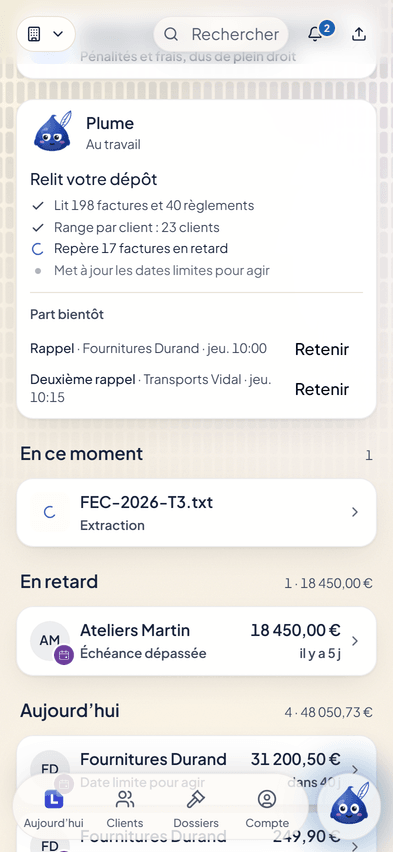
Reminders in your nameReminders and the formal letter go out in your name, and each one can be held back beforehand.
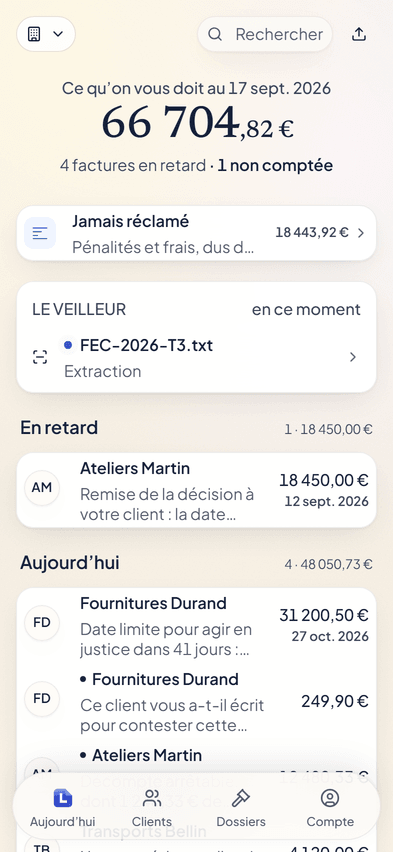
Penalties to the centThe penalties and costs due on each invoice, detailed period by period.
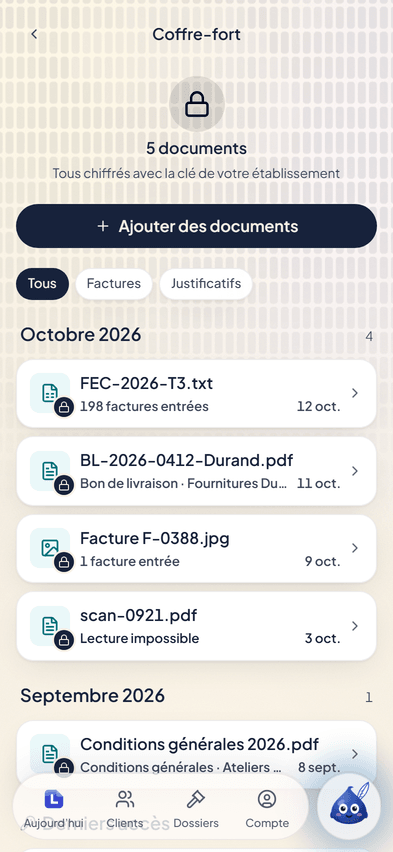
The vaultEvery document is sealed on arrival, and every opening is logged.
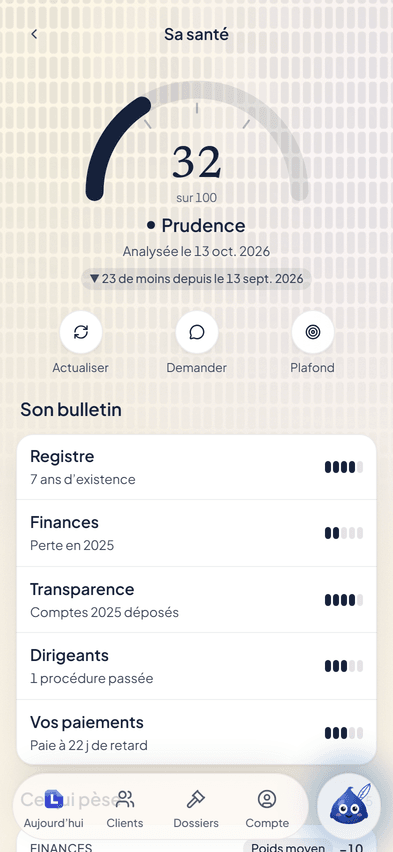
The health of your clientsA score out of one hundred, and each of the facts that move it, at its source.
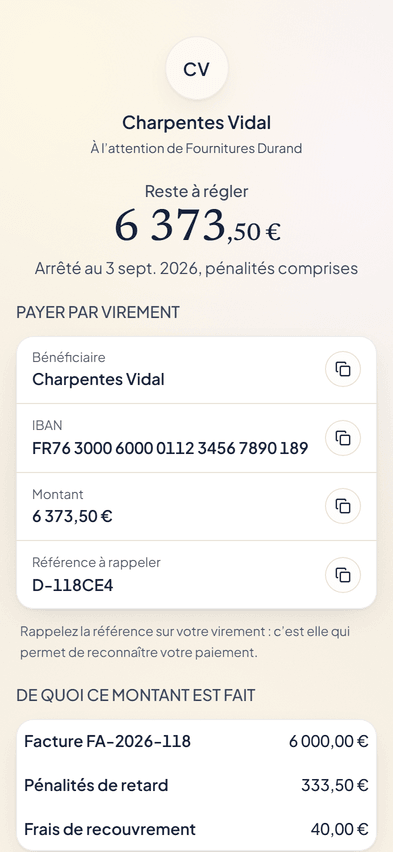
The payment pageYour client pays by bank transfer, into your account, from a page in your name.
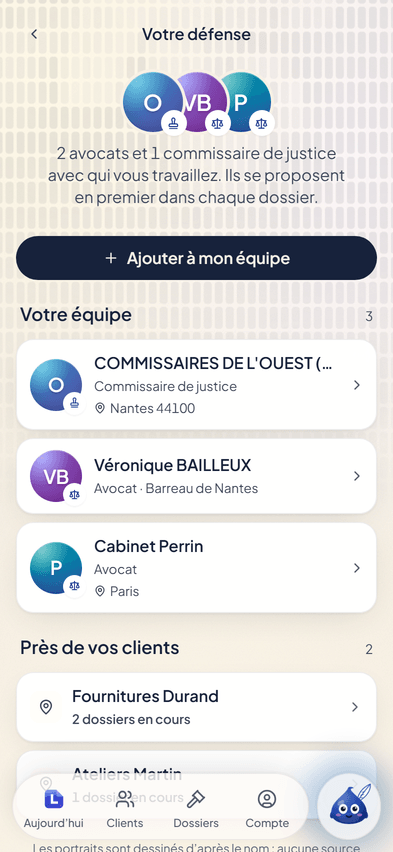
Your defenceThe lawyers and bailiffs (commissaires de justice) practising near your client, their contact details, and the case file ready to hand over to them.
Upload an export or connect your software: you see what you are owed within minutes. 30-day trial, €0 today, no commitment.
Une facture impayée ne fait aucun bruit...
An unpaid invoice makes no noise on the day it becomes impossible to claim before a judge. No alert, no letter: the period expires, and that is that.
This period has a legal name: limitation. It varies according to your line of business, it starts on a specific day, and it stops only in cases listed by law. A reminder, even a formal one, is not among them.
Why a time limit exists
The law does not allow a debt to be claimed indefinitely. After a certain period, you can no longer ask a court to make your customer pay.
This period is not shown anywhere on the invoice. That is why it gets missed: an invoice is kept ‘for later’, you wait for the customer to be in a better position, and by the day you want to act, it is too late.
How long, depending on your activity
Between businesses, in general5 ans
Sale to a private individual2 ans
Carriage of goods1 an
The time limit runs from its starting point, which differs depending on the case.
Between businesses, generally: 5 ans (article L110-4 du code de commerce).
This is the most common case: a joinery firm invoicing a company, an agency invoicing a business customer.
For the carriage of goods: 1 an
(article L133-6 du code de commerce). This short period covers all actions arising from the contract of carriage, including payment of the price. If you are a carrier, your transport invoices must be claimed within this period, not the general one. It applies to road transport within France; international, maritime or air transport falls under other rules.
For what a business supplies to a private individual: 2 ans
(article L218-2 du code de la consommation). Note that ‘private individual’ means a natural person. An association, for example, falls under the general period.
When the time limit starts running
The starting point is not the same in every case.
General case: Le jour où le créancier a connu ou aurait dû connaître les faits lui permettant d’agir.
Carriage of goods: Le jour où la marchandise a été remise ou offerte au destinataire ; en cas de perte totale, le jour où la remise aurait dû être effectuée.
Sale to a private individual: Selon le droit commun, la fourniture du bien ou du service.
For an unpaid invoice between businesses, this day is most often the due date: that is when you know your customer has not paid. In a particular situation, the exact starting point should be confirmed by a lawyer.
The registered-letter trap
This is the most widespread mistake. Many managers think that a formal demand letter sent by registered post ‘stops the clock’. It does not: a formal demand letter, even sent by registered post with acknowledgement of receipt, does not interrupt the limitation period (Cour de cassation, chambre commerciale, 18 mai 2022, n° 20-23.204 [publié]).
The list of acts that do interrupt it is closed, set by the Civil Code. Anything not on it, however firm, leaves the clock running.
Interrupts the period
Your customer acknowledging the debt
A claim brought before a court
A protective measure
An act of enforcement
Does not interrupt the period
A reminder by email
A phone call
An ordinary letter
A formal demand letter, even by registered post with acknowledgement of receipt
The formal demand letter remains useful: it records the delay and clearly asks for payment. It simply does not protect against the deadline.
Spotting invoices that are nearing the deadline
Three habits are enough to avoid being caught out.
1
Sort unpaid invoices by due date
The oldest is not always the largest, but it is the one whose period expires first.
2
Note each customer’s line of business
Transport, sale to a private individual, trade between businesses: this is what sets the period. If in doubt, use the shortest period.
3
Review the list every month
An invoice whose period is approaching calls for a decision: claim it, negotiate it or let it go. A decision taken in time, whichever it is, is better than a period that expires in silence.
What Letikette does
Letikette calculates the deadline for each invoice, using the period for its sector, and monitors it every night. When a customer’s sector is not known, it applies the shortest period and tells you so: you always know which assumption the displayed date rests on.
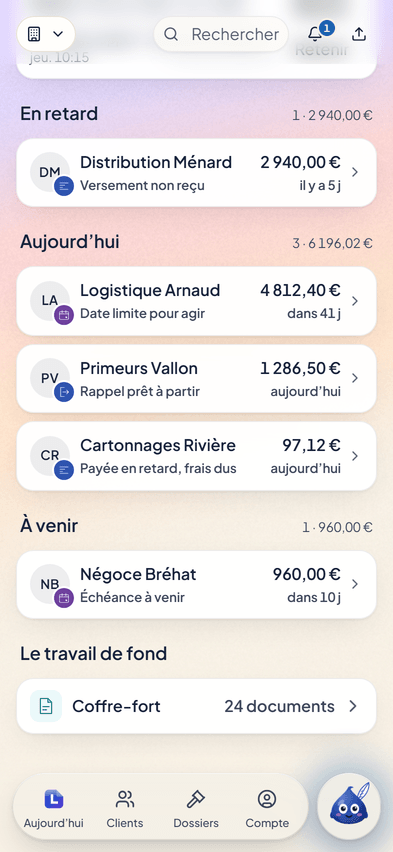
Letikette’s cards for a carrier: an invoice whose deadline for taking action falls in 41 days, at the top of what is most pressing.
This article presents general rules. It does not constitute legal advice: the decision to take action, and how to do so, remain yours.