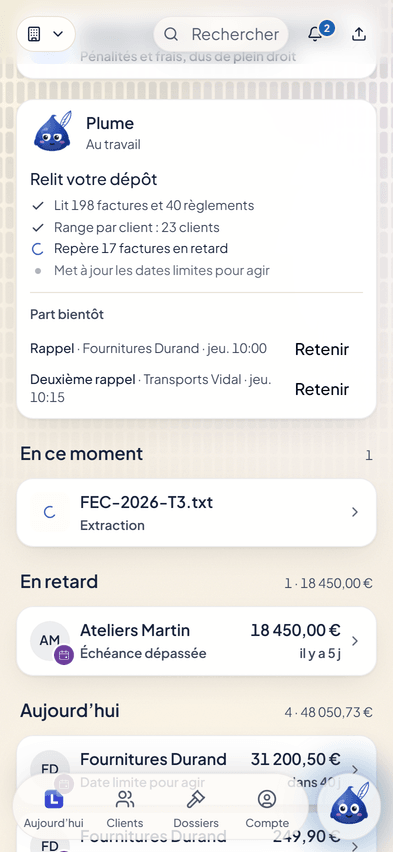
Reminders in your nameReminders and the formal letter go out in your name, and each one can be held back beforehand.
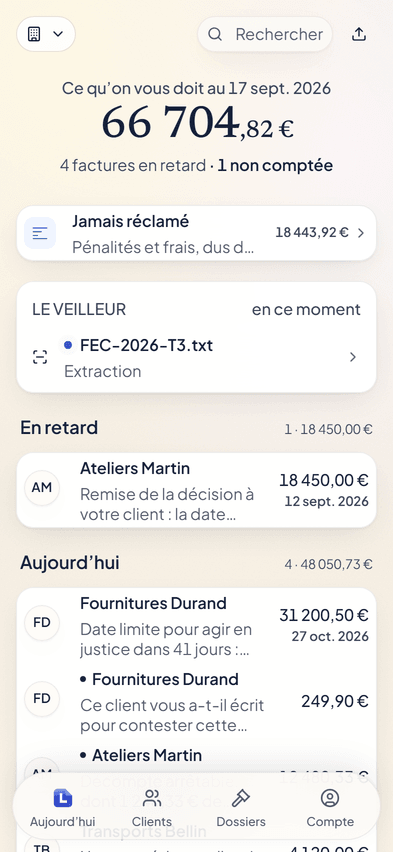
Penalties to the centThe penalties and costs due on each invoice, detailed period by period.
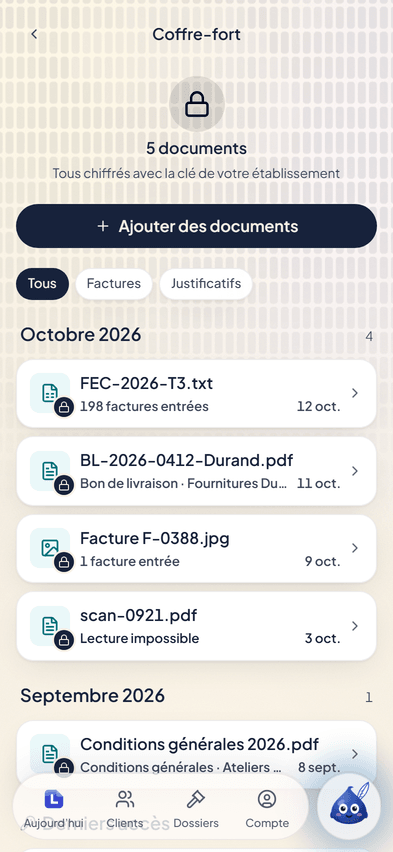
The vaultEvery document is sealed on arrival, and every opening is logged.
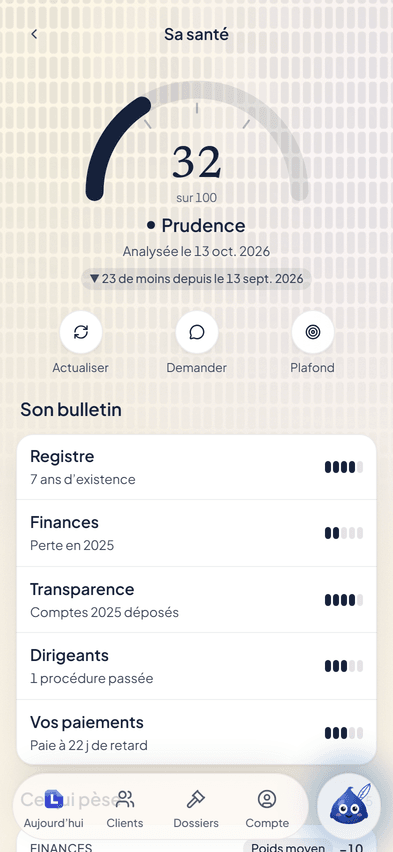
The health of your clientsA score out of one hundred, and each of the facts that move it, at its source.
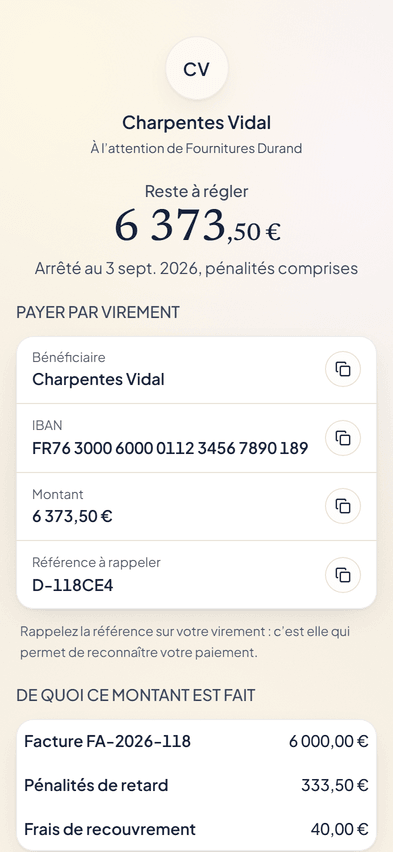
The payment pageYour client pays by bank transfer, into your account, from a page in your name.
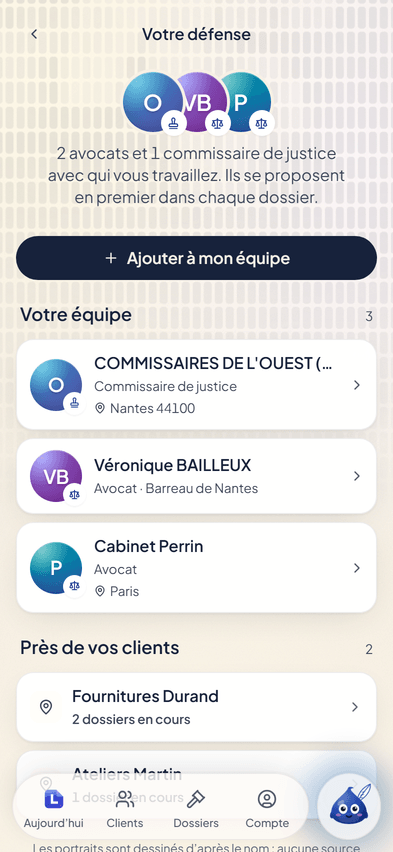
Your defenceThe lawyers and bailiffs (commissaires de justice) practising near your client, their contact details, and the case file ready to hand over to them.
With no written payment term, how long does your client have?
If your terms set no payment period, the law sets one, counted from the service. And even when agreed, a period has upper limits. The rules between businesses.
Without a contract30 daysafter delivery or performance of the service
Upload an export or connect your software: you see what you are owed within minutes. 30-day trial, €0 today, no commitment.
Many service businesses send their invoices with no payment term, or with a vague "on receipt". The client pays when they can, and nobody really knows from when they are late. The law does know: between businesses, the payment term is regulated, whether or not it is written down.
No agreed term: the term set by law
When neither your terms of sale nor your agreement with the client sets a term, the law provides one: payment "must not exceed" 30 days "after the date of receipt of the goods or performance of the service requested" (article L441-10 I, premier alinéa, du code de commerce).
Two points to note.
The term runs from the service, not from the invoice. An invoice sent three weeks after the end of the assignment does not add three weeks to the client's term.
It is a maximum term: nothing prevents you from asking for faster payment in your terms.
An agreed term has upper limits
You can agree a longer term with your client, but not without limit. The agreed term cannot exceed 60 days after the invoice issue date. As an exception, it can run to 45 days end of month after the invoice, provided that this is expressly stated in the contract and does not amount to "a manifest abuse towards the creditor" (article L441-10 I, deuxième à quatrième alinéas, du code de commerce).
For a periodic invoice, one that groups several deliveries or services over the same period, the ceiling is 45 days after the invoice.
These ceilings apply to most trades. Some sectors have their own, shorter rules: road haulage, for example, has its own specific ceiling.
Write a due date
The simplest approach is still to write a precise due date on every invoice. It is the starting point for penalties: they run from the "day following the payment date shown on the invoice" (article L441-10 II du code de commerce).
What accrues after the due date
Once the due date has passed, the law attaches two sums to the late payment, without any reminder or clause.
Late-payment penalties, at the ECB rate plus dix points, which is 12,40 % a year this half-year (article L441-10 II du code de commerce).
A fixed recovery fee of €40 per invoice (article D441-5 du code de commerce, version en vigueur depuis le 27 février 2021 [décret n° 2021-211, art. 3]).
Take the example of a communications agency that delivers a campaign at the end of June and invoices €6,800 with no payment term. Its client pays in mid-September. Even with no written term, the delay began well before that: here is what the law adds, for an example due date of 30 July.
An invoice of €6,800, due on 30 July 2026What it is worth on 15 September 2026, with no payment in the meantime.
Calculated by the Letikette engine, on a 365-day basis. Each line can be checked with a calculator: amount × rate × days ÷ 365. Days are counted from the due date included to the cut-off date excluded: the same total as from the day after the due date to the cut-off date included.
What Letikette does
Letikette reads the due date of each invoice. When an invoice does not show one, it applies the statutory term, counted from the invoice date, and flags it as an assumption. It then calculates the penalties and fees on each invoice paid late, to the cent.
This article presents general rules. It does not constitute legal advice: the decision to take action, and how to do so, remain yours.