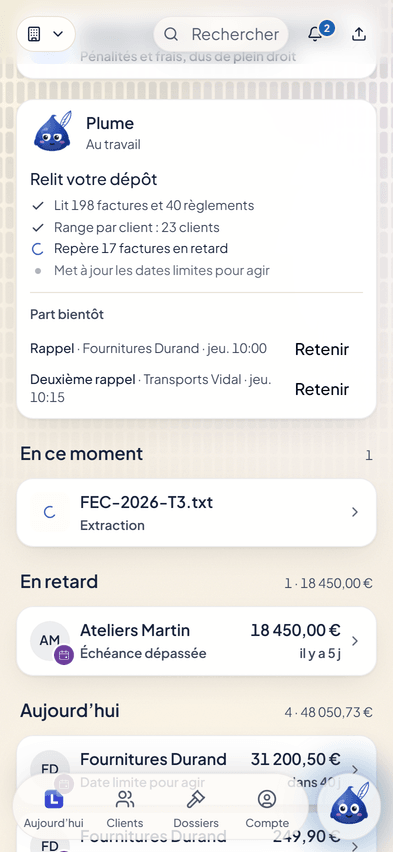
Reminders in your nameReminders and the formal letter go out in your name, and each one can be held back beforehand.
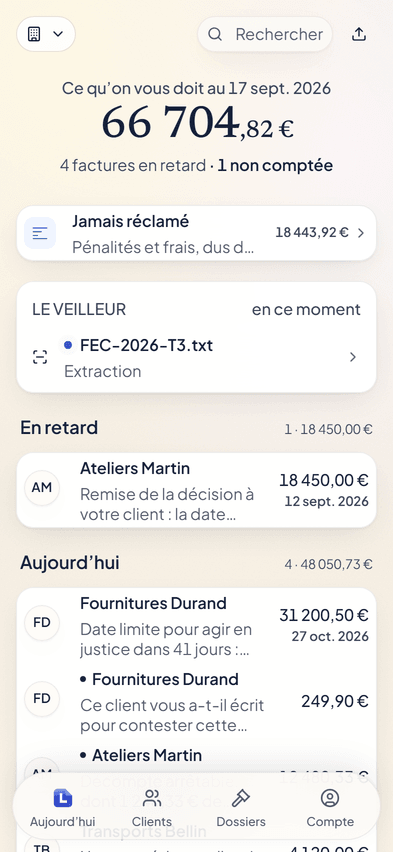
Penalties to the centThe penalties and costs due on each invoice, detailed period by period.
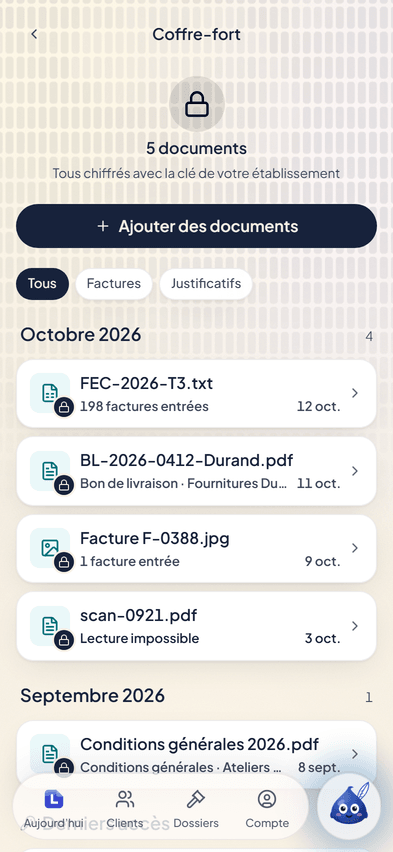
The vaultEvery document is sealed on arrival, and every opening is logged.
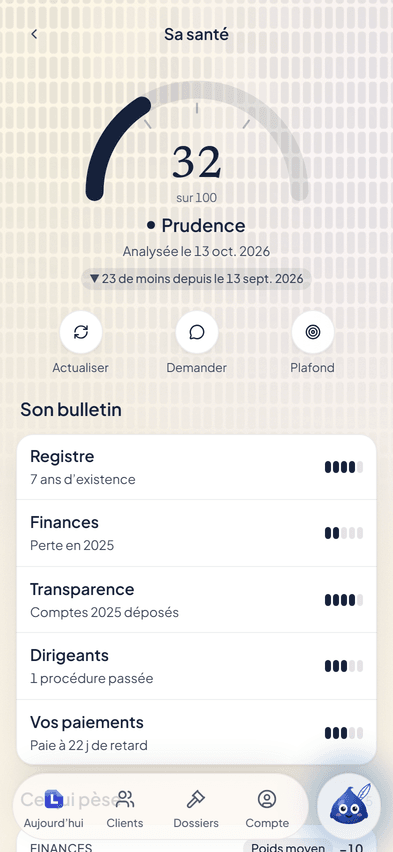
The health of your clientsA score out of one hundred, and each of the facts that move it, at its source.
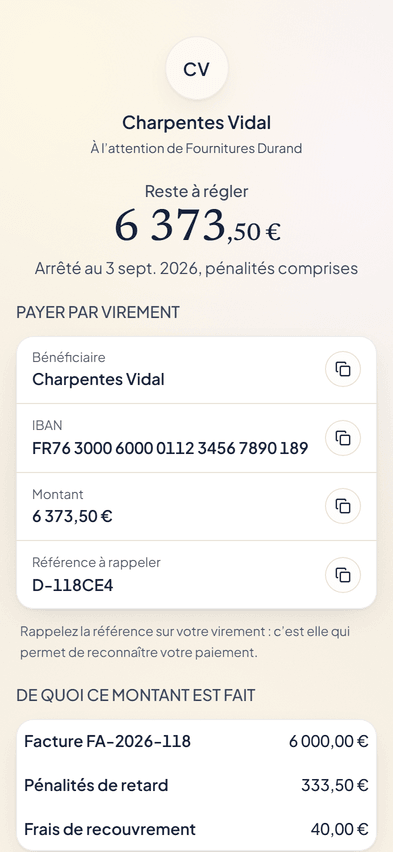
The payment pageYour client pays by bank transfer, into your account, from a page in your name.
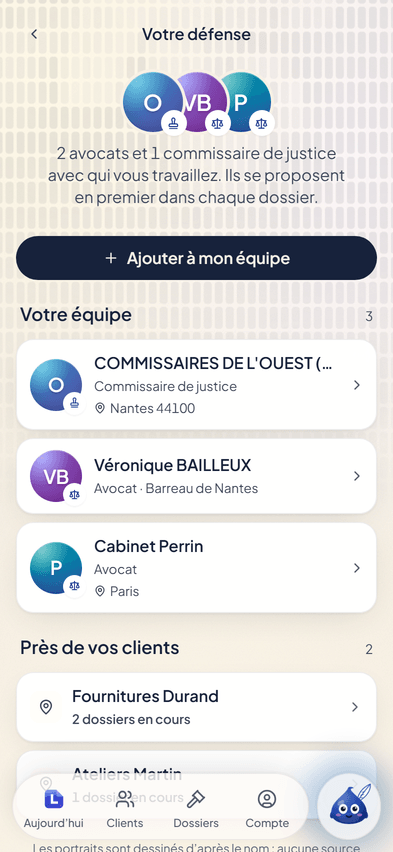
Your defenceThe lawyers and bailiffs (commissaires de justice) practising near your client, their contact details, and the case file ready to hand over to them.
Upload an export or connect your software: you see what you are owed within minutes. 30-day trial, €0 today, no commitment.
It is the sum most often forgotten on unpaid invoices. It requires no calculation and is due automatically, yet very few businesses claim it: the fixed fee for recovery costs, of €40 per invoice.
Here is where it comes from, what it applies to, and what it does not cover.
Where this compensation comes from
The law is direct: ‘any professional in a situation of late payment is automatically liable’ for a fixed fee for recovery costs (article L441-10 II du code de commerce). Its amount is set by decree: €40 (article D441-5 du code de commerce, version en vigueur depuis le 27 février 2021 [décret n° 2021-211, art. 3]).
‘Automatically’ means exactly that. You do not have to prove that the delay cost you anything, or to have written it into a contract. The delay is enough.
One indemnity per invoice, not per client
This is the point that changes everything. The administration states it plainly: the fee ‘applies to each invoice that has not been paid on time’ (Service-Public Entreprendre, fiche F23211 [lecture de l’administration]).
Take a wholesaler as an example. She delivers to a restaurant every week and invoices each delivery. The restaurant goes through a difficult month and pays six invoices three weeks late. It does not owe one fee, but six.
Invoice 01+ €40
Invoice 02+ €40
Invoice 03+ €40
Invoice 04+ €40
Invoice 05+ €40
Invoice 06+ €40
6 invoices × €40€240
One client, several invoices paid late: recovery costs for each one.
One clarification: the fee applies only once per invoice, however long the delay. It also remains due even when your client has eventually paid the invoice: the delay did happen.
It is added to late payment penalties
Recovery costs and late-payment penalties are two different things, and they can be combined.
The penalties pay for time: they grow every day the invoice remains unpaid.
The fee is a fixed sum: €40, once per invoice, from the first day of delay.
On a small invoice, the fee often weighs more than the penalties. For an invoice of €800 paid one month late, the penalties come to a few euros; the fee, for its part, is €40. The calculation of the penalties is detailed in our article on late-payment penalties.
When your costs exceed the fixed amount
The fixed fee covers the ordinary costs of a reminder. If recovery costs you more, for example because you had to pay a professional, the law provides a next step: ‘where the recovery costs incurred exceed the amount of this fixed fee, the creditor may claim additional compensation, on justification’ (article L441-10 II du code de commerce).
‘On justification’ means you must be able to show these costs: invoices, receipts. Without supporting documents, you remain at the fixed fee.
The case of insolvency proceedings
There is one exception. The creditor ‘may not rely on the benefit of these fees where the opening of’ insolvency proceedings prohibits payment on the due date (article L441-10 II, dernière phrase, du code de commerce).
In practice, if your client is placed in court-supervised reorganisation or in liquidation, an invoice whose due date falls on the day of the judgment or after it does not give entitlement to recovery costs. For an invoice that fell due before the judgment, Letikette takes the view that the fee can still be claimed, and flags this as a reading of the texts.
Claiming it, or not
Nothing obliges you to claim this fee. Many managers waive it to protect a relationship, and that is a commercial choice that is yours to make.
Knowing about it simply lets you choose with full knowledge. And when a client negotiates a payment schedule, knowing what you are owed gives you a point of support in the discussion.
What Letikette does
Letikette adds the fee to each invoice paid late, only once, and sets it aside by itself when insolvency proceedings prohibit it. The statement shows it on its own line, next to the penalties, so that your client sees exactly where each euro comes from.
This article presents general rules. It does not constitute legal advice: the decision to act, and how to do so, remain yours.