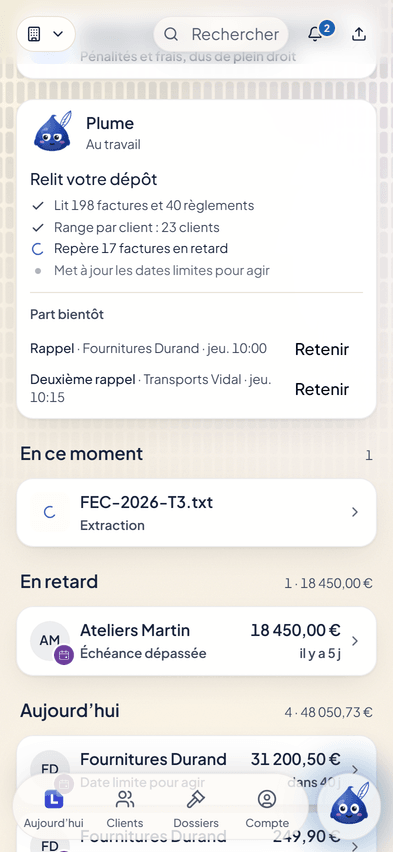
Reminders in your nameReminders and the formal letter go out in your name, and each one can be held back beforehand.
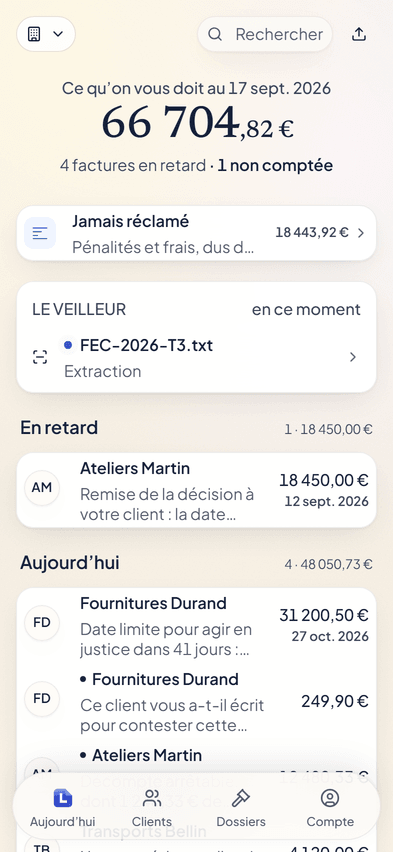
Penalties to the centThe penalties and costs due on each invoice, detailed period by period.
The vaultEvery document is sealed on arrival, and every opening is logged.
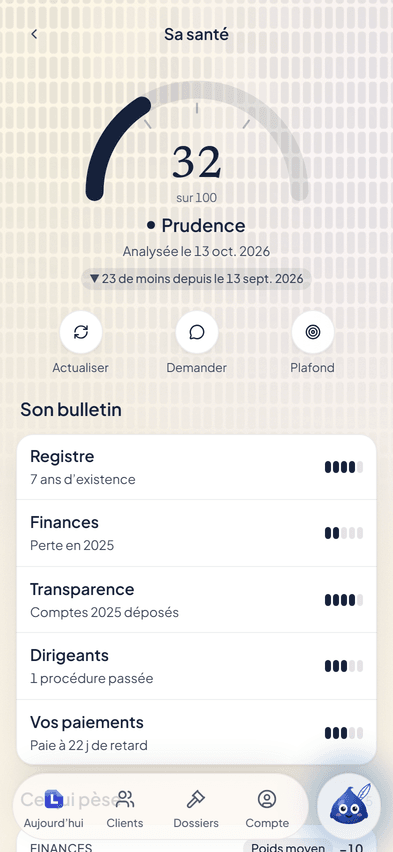
The health of your clientsA score out of one hundred, and each of the facts that move it, at its source.
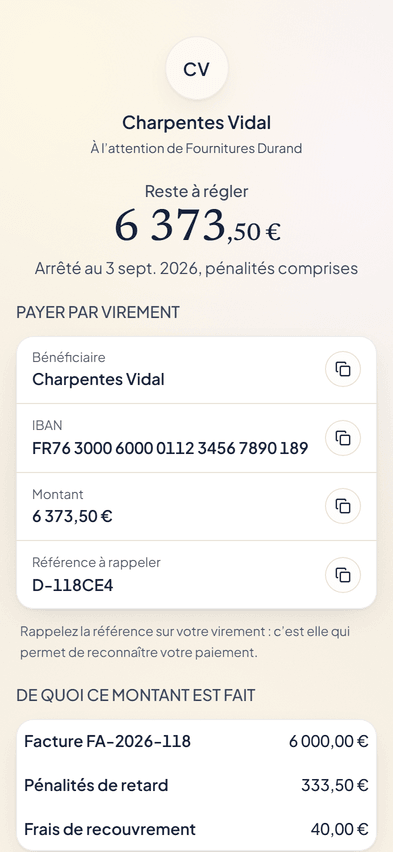
The payment pageYour client pays by bank transfer, into your account, from a page in your name.
Your defenceThe lawyers and bailiffs (commissaires de justice) practising near your client, their contact details, and the case file ready to hand over to them.
Upload an export or connect your software: you see what you are owed within minutes. 30-day trial, €0 today, no commitment.
Your shipper imposes ‘payment at 60 days end of month’ in its framework contract. You sign, because the volume matters and everyone does the same. What many hauliers do not realise is that, in their trade, the law sets a shorter ceiling, and no clause can exceed it.
A ceiling specific to transport
In most trades, the payment period agreed between businesses can be up to 60 days after the invoice, or 45 days end of month if the contract expressly provides for it (article L441-10 I, deuxième à quatrième alinéas, du code de commerce).
Road haulage is an exception. The payment period ‘may not exceed’ 30 days after the invoice issue date (article L441-11, II, 5°, du code de commerce).
The same rule applies to:
vehicle hire, with or without a driver;
transport commission agency;
the activities of freight forwarders, shipping agents and air freight agents, freight brokers and customs agents.
A ceiling, not a preference
The difference from the ordinary period is important. The general period applies ‘unless otherwise provided’: the parties may agree something different, within the ceilings. The transport period is itself a ceiling: a contract can provide for a shorter period, never a longer one.
A ‘60 days end of month’ clause in a road haulage contract therefore does not change the date from which your customer is late. It falls due 30 days after the invoice.
From the invoice, not from delivery
The starting point is the invoice issue date. That is a good reason to invoice quickly: an invoice issued three weeks after delivery pushes back, by as much, the date on which lateness begins.
There is another consequence, linked to the time limit for taking legal action: for a transport invoice, it runs from delivery, and it is short. The later the invoice goes out, the less time remains once the delay is established. We explain this in our article on the time limit for acting on transport invoices.
What accrues from the first day of delay
Once the ceiling has passed, your customer is late, and the law attaches two sums to that, with no reminder and no clause needed.
Late-payment penalties, at the ECB rate plus dix points, i.e. 12,40 % a year for the current half-year, ‘payable without any reminder being necessary’ (article L441-10 II du code de commerce).
A fixed recovery fee of €40 per invoice (article D441-5 du code de commerce, version en vigueur depuis le 27 février 2021 [décret n° 2021-211, art. 3]).
Take the example of a haulier whose invoice, under the rule for its trade, fell due on 1 October. The shipper, true to its ‘60 days end of month’, pays at the end of November.
An invoice of €6,200, due on 1 October 2026What it is worth on 30 November 2026, with no payment in the meantime.
Calculated by the Letikette engine, on a 365-day basis. Each line can be checked with a calculator: amount × rate × days ÷ 365. Days are counted from the due date included to the cut-off date excluded: the same total as from the day after the due date to the cut-off date included.
Telling your client
Reminding a customer of this ceiling is not aggressive: it is a rule of your trade, which the customer is expected to know. It can be written on your invoices and your general terms and conditions, together with the resulting due date. The day a customer pays beyond it, the discussion starts from a text, not from a balance of power.
What Letikette does
Letikette calculates the due date of each invoice and the sums the law adds when it is paid late. It also monitors the time limit for taking action on each transport invoice, based on the period specific to transport, and alerts you before it passes.
This article presents general rules. It does not constitute legal advice: the decision to take action, and how to do so, remain yours.