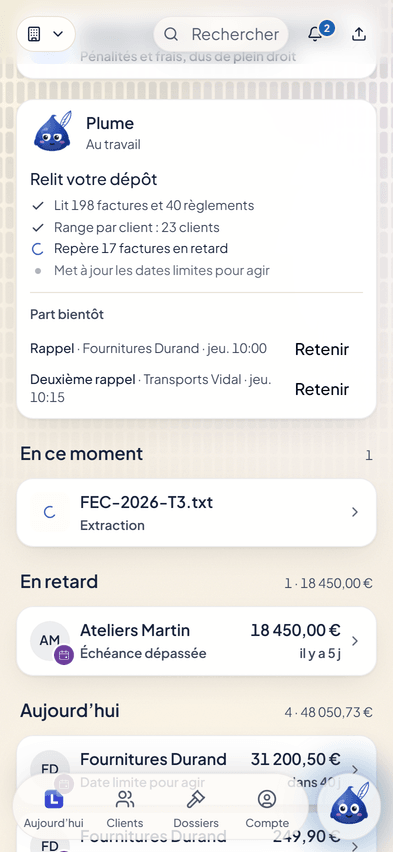
Reminders in your nameReminders and the formal letter go out in your name, and each one can be held back beforehand.
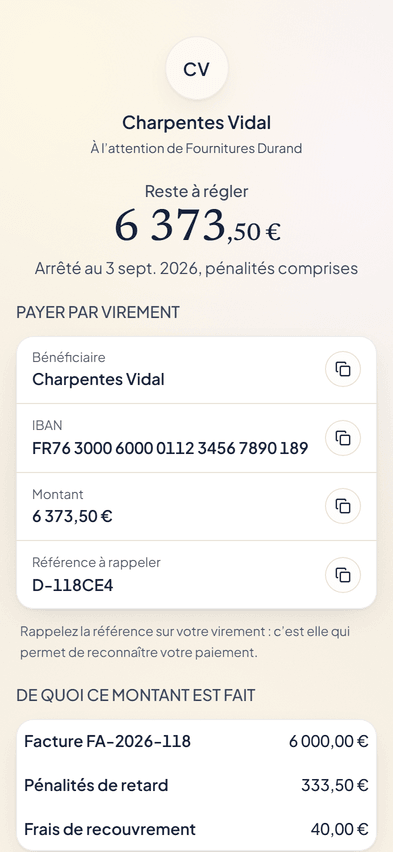
Penalties to the centThe penalties and costs due on each invoice, detailed period by period.
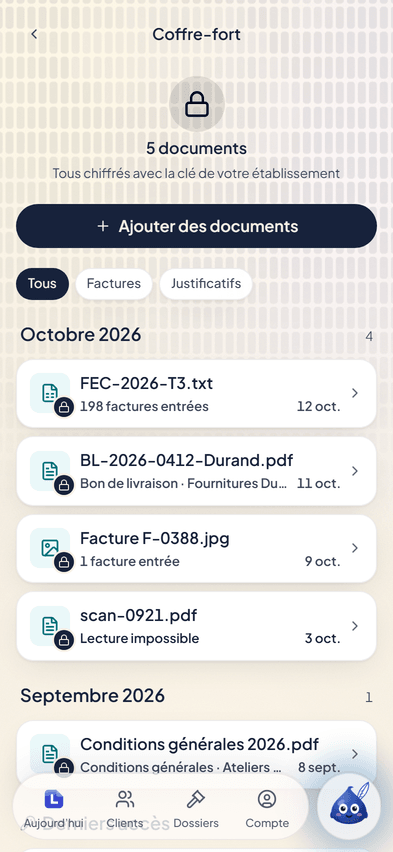
The vaultEvery document is sealed on arrival, and every opening is logged.
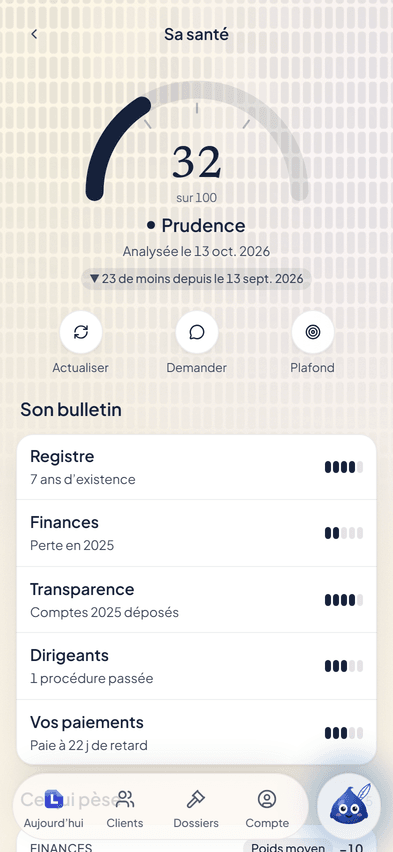
The health of your clientsA score out of one hundred, and each of the facts that move it, at its source.
The payment pageYour client pays by bank transfer, into your account, from a page in your name.
Your defenceThe lawyers and bailiffs (commissaires de justice) practising near your client, their contact details, and the case file ready to hand over to them.
Unpaid transport invoice: a much shorter deadline to take action
An invoice for road haulage can be claimed in court for much less time than others, and the period runs from delivery, not from the invoice. What to watch.
Key pointsDeliverystarts the time limit for taking action
Upload an export or connect your software: you see what you are owed within minutes. 30-day trial, €0 today, no commitment.
In most trades, an unpaid invoice can be claimed in court within 5 ans: there is time to chase, negotiate and wait. In road freight, that period drops to 1 an. It is the shortest rule a haulier meets on its invoices, and the least well known.
All actions arising from carriage
People first think of disputes over damaged or lost goods. But the text goes further: ‘all other actions to which this contract may give rise, whether against the carrier or the freight forwarder, or against the consignor or the consignee’ are also time-barred after 1 an
(article L133-6 du code de commerce). A carrier's action to claim its price is one of them.
In other words, once this period has passed on a domestic road freight invoice, it can in principle no longer be claimed before a court. The customer may still pay it of its own accord, but you can no longer compel it to.
Between businesses, in general5 ans
Sale to a private individual2 ans
Carriage of goods1 an
The time limit runs from its starting point, which differs depending on the case.
The time limit starts at delivery, not at the invoice
This is the most common mistake: counting the period from the invoice date, or from its due date. The starting point under the text is different: Le jour où la marchandise a été remise ou offerte au destinataire ; en cas de perte totale, le jour où la remise aurait dû être effectuée.
Take a sample haulier who delivers to a shipper on 28 October and invoices the carriage on 15 November, payable at thirty days, so in mid-December. If it counts its period from the due date, it is out by six weeks: the period began on the day of delivery.
When you invoice all the month's deliveries at month end, the gap widens further: the first delivery of the month began using up its period three or four weeks before the invoice went out.
A reminder does not stop the clock
Many hauliers send reminders for months, convinced that a letter or a phone call ‘preserves’ their rights. It does not. The Cour de cassation has restated that a letter demanding payment does not interrupt the time limit for taking legal action
(Cour de cassation, chambre commerciale, 18 mai 2022, n° 20-23.204 [publié]).
A sector under strain
The risk is not theoretical. According to
Altares,
transport and logistics companies were themselves paying their suppliers 16 days late on average at the end of 2025, one of the highest levels in the economy: if you work as a subcontractor for other hauliers or freight forwarders, that figure is the one your customers show. And the
Banque de France
recorded 3,235 business failures in transport and warehousing over the twelve months to July 2026, 70% more than the average for 2010 to 2019.
A customer that pays later and later is often a customer in difficulty. With a time limit this short, waiting for it to recover can cost you the entire invoice.
What the rule does not cover
Two limits, so that you do not apply the rule wrongly.
It covers domestic land transport. International road haulage, sea freight and air freight fall under other texts, with their own time limits.
The law makes an exception for cases of fraud or breach of trust.
For your other invoices, those that do not relate to carriage, the general time limit applies: 5 ans (article L110-4 du code de commerce).
What Letikette does
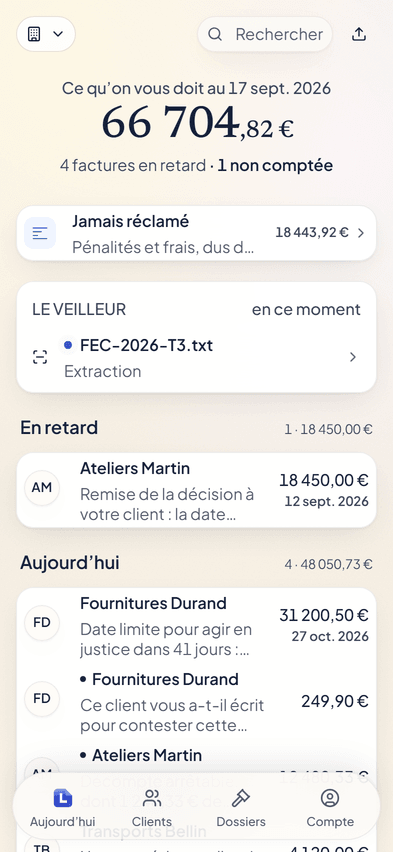
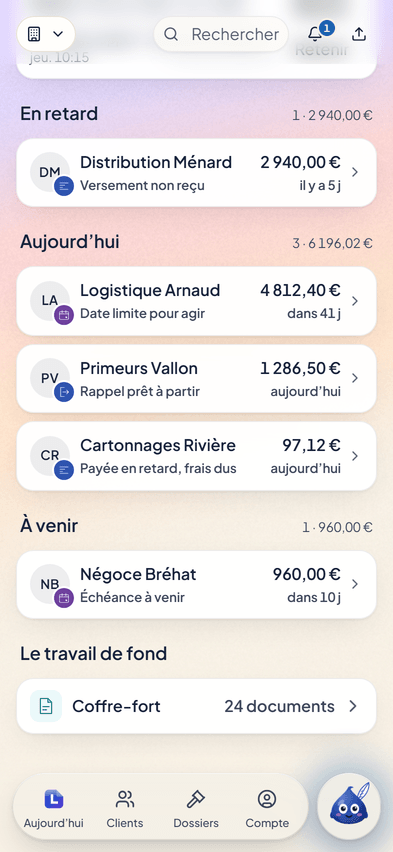
Letikette tracks the deadline for taking legal action on each carriage invoice, using the time limit specific to carriage, and alerts you well before it passes. On your screen, the customer card shows how much it owes you and in how many days its time limit expires. What you do with that remains your decision.
Letikette cards for a haulier: a deadline for legal action in 41 days, a reminder ready to send, an invoice paid late.
This article sets out general rules. It does not constitute legal advice: the decision to take action, and how to go about it, remain yours.