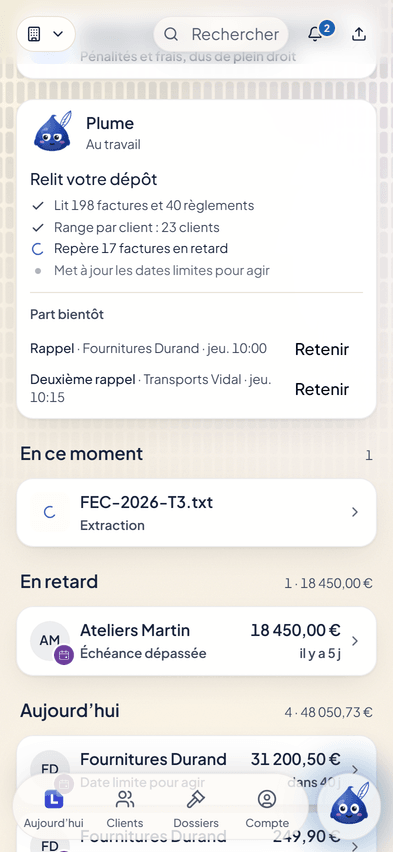
Reminders in your nameReminders and the formal letter go out in your name, and each one can be held back beforehand.
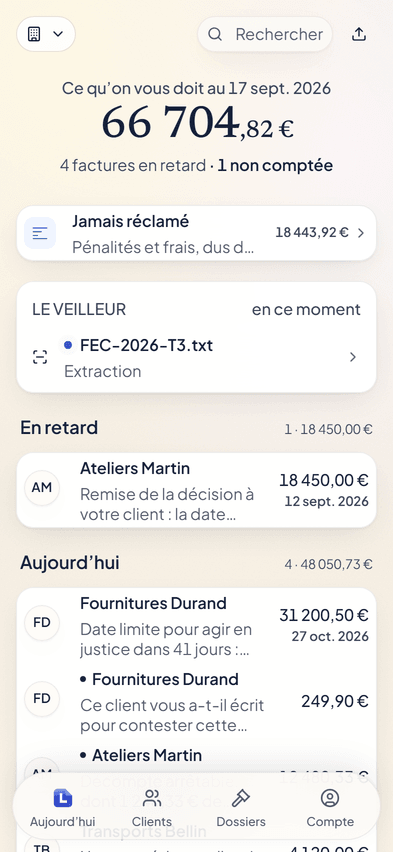
Penalties to the centThe penalties and costs due on each invoice, detailed period by period.
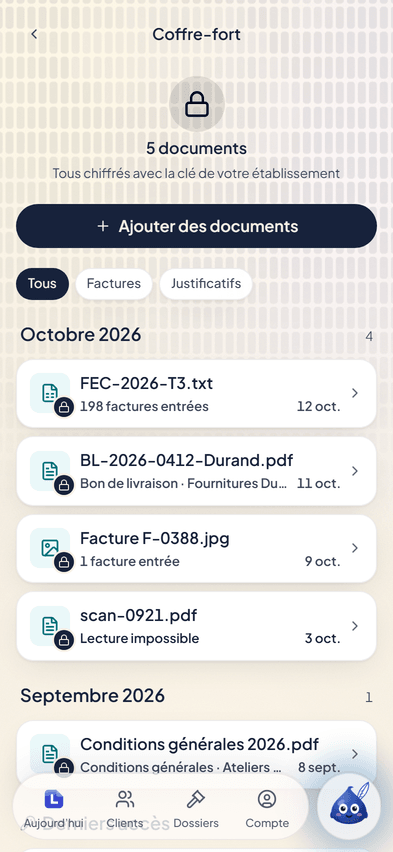
The vaultEvery document is sealed on arrival, and every opening is logged.
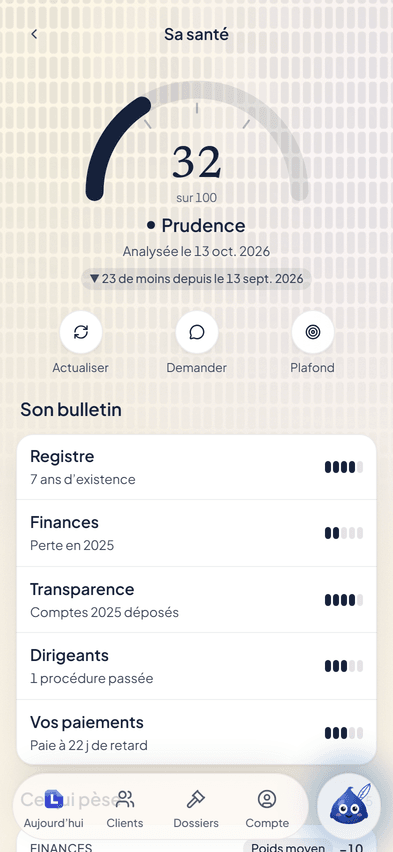
The health of your clientsA score out of one hundred, and each of the facts that move it, at its source.
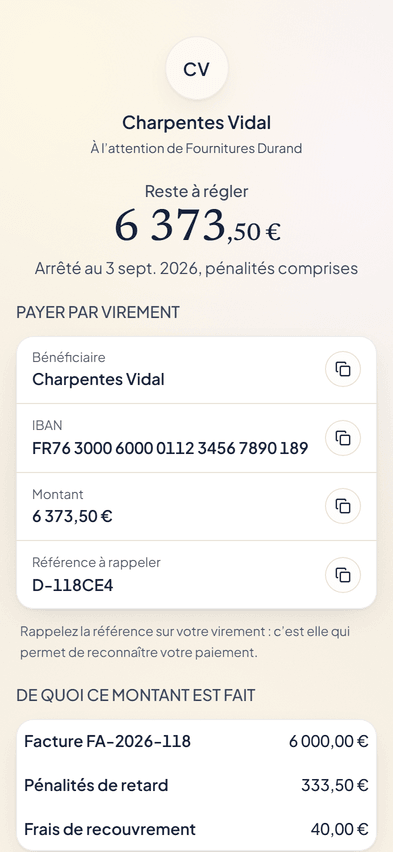
The payment pageYour client pays by bank transfer, into your account, from a page in your name.
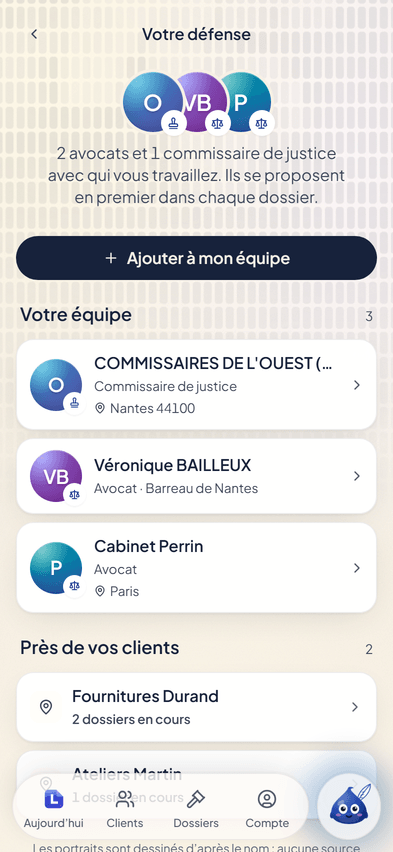
Your defenceThe lawyers and bailiffs (commissaires de justice) practising near your client, their contact details, and the case file ready to hand over to them.
Your client asks to pay in instalments: how to accept without losing out
A well-written payment schedule brings the money in and protects your claim. What it must contain, the penalties, and what happens if an instalment is missed.
Key pointsIn writingan agreement that acknowledges what is owed
Upload an export or connect your software: you see what you are owed within minutes. 30-day trial, €0 today, no commitment.
« I can't pay everything now, but I can pay in four instalments. » For a small business, that is often the best news an overdue invoice can bring: your client is not disputing the debt, they want to pay. But the agreement needs to protect you as well as them.
Here is how to accept a payment plan without losing anything along the way.
You are not obliged to accept
The law is clear: you can refuse a partial payment, even when the amount owed can be divided (article 1342-4 du code civil). A payment plan is therefore a favour you grant, not a right your client holds.
That is also what lets you set the terms. Agreeing verbally to "let's do it in four instalments" settles nothing: not the dates, not the amounts, and not what happens at the first late payment.
Before agreeing, work out what is owed
An agreement covers a specific sum. Before proposing one, fix the calculation at a given date: the amount of the invoices, the late-payment penalties accrued up to that date, and the recovery costs (€40 per invoice). Each item must be possible to recalculate by hand, invoice by invoice.
This is the figure your client will acknowledge. If it is wrong, or if it leaves out an invoice, the agreement records that wrong figure as acknowledged.
What a good agreement contains
1
The acknowledgement of debt
Your client acknowledges owing a specific sum, fixed at a given date, invoice by invoice. The
signatory writes the amount out by hand, in words and in figures.
2
The schedule
The number of instalments, the amount of each and the due date of each. Payment is made by bank
transfer to your account, quoting a reference.
3
The order of allocation
Which invoice, and which item, each instalment is set against.
4
Penalties during the payment plan
Whether they continue to accrue or whether you waive them, and on what condition.
5
Default
What happens if an instalment does not arrive on its due date.
6
The signatures
Yours, and that of a person with the authority to bind your client, with their name and job
title.
For a debt of €8,400, paid in four monthly instalments, the schedule looks like this:
Instalment 1€2,1005 November 2026
Instalment 2€2,1005 December 2026
Instalment 3€2,1005 January 2027
Instalment 4€2,1005 February 2027
An example payment schedule: the sum due, split into equal monthly instalments.
When the sum does not divide exactly to the cent, the remainder goes on the last instalment. The total stays exact.
The order in which payments are allocated
Without a specific clause, a partial payment is allocated first to interest (article 1343-1, alinéa 1, du code civil), meaning the late-payment penalties, before the invoice amount. The contract can provide for a different order.
Writing this order into the agreement avoids any argument at the end: everyone can check, instalment by instalment, what remains due. Our article on partial payments covers these rules in detail.
Penalties during the payment plan
This is a commercial decision, and it is yours to make. Two options are common.
Waive them, on condition
Keep them
During the schedule
They do not accrue, as long as each instalment is paid on time
They accrue on the amount still owed
At the first default
The waiver lapses and they become due again
Nothing changes
The total to be paid
Known from the signature
Known at the last instalment
A conditional waiver rewards the client who keeps their commitments, and costs you nothing if they do not. Keeping the penalties requires you to set out precisely how they are calculated during the schedule.
If an instalment is missed
An agreement with no default clause leaves you without recourse at the first late payment. The most common clause works in three stages:
an instalment does not arrive on its due date;
you send your client formal notice to put things right, by registered letter, giving them a period set out in the agreement;
if they have not put things right within that period, they lose the benefit of the schedule: everything still owed becomes payable immediately.
Add that a delay tolerated once does not amount to a waiver of your right to rely on it the next time.
What the agreement changes for the deadline to take action
An invoice has a deadline after which you can no longer claim payment through the courts. A formal notice, even by registered letter, does not push it back: the French Court of Cassation has restated that the list of acts that interrupt it is closed, and that the debtor's acknowledgement is one of them (Cour de cassation, chambre commerciale, 18 mai 2022, n° 20-23.204 [publié]).
An agreement in which your client acknowledges in writing that they owe the sum is therefore much more than a courtesy. Keep the signed original.
When not to sign
If your client is subject to insolvency proceedings (safeguard, court-supervised reorganisation or liquidation), an agreement of this kind cannot be signed with them: their debt is no longer settled directly. The step to take is then filing your claim, explained in our article on redressement judiciaire.
What Letikette does
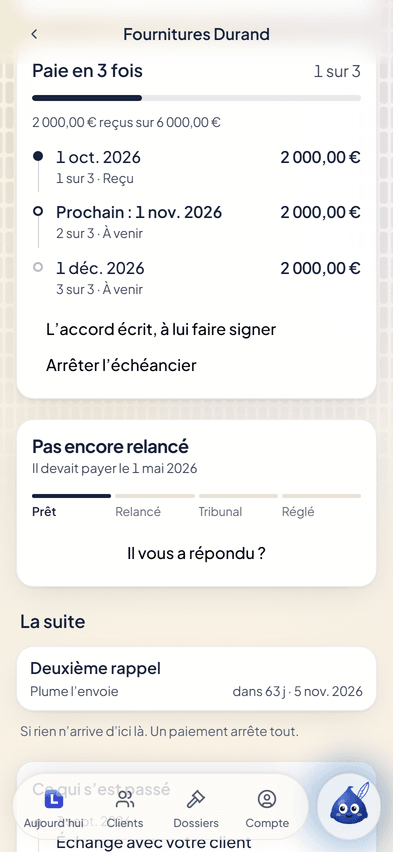
Letikette prepares the acknowledgement of debt and the payment plan agreement in your name, from a statement dated that day and broken down by item, with the schedule to the cent and your IBAN. The software suggests your client's signatory based on the directors published in the register, and declines to prepare the agreement if your client is in insolvency proceedings. You choose the number of instalments, their dates and the period to put things right; you review, then you sign. For now, the agreement it prepares provides for the conditional waiver of penalties; keeping them is not yet offered.
A payment in three instalments in Letikette: each instalment and its date, what has already been received, and the written agreement to be signed.
This article sets out general rules and common practice. It does not constitute legal advice: the decision to grant a payment plan, and its terms, remain yours.