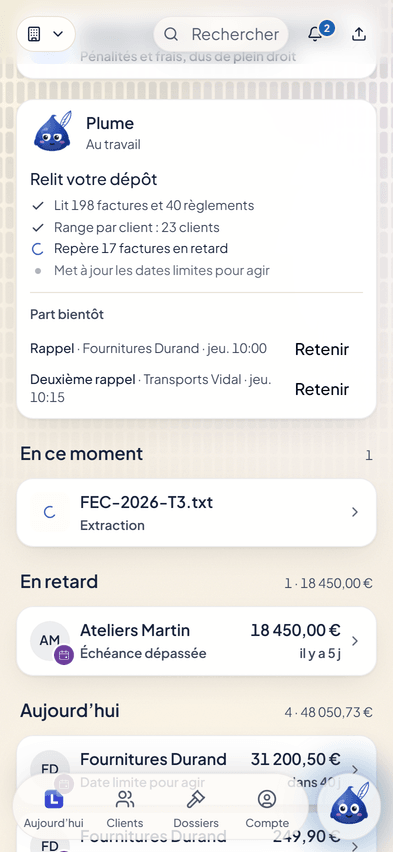
Reminders in your nameReminders and the formal letter go out in your name, and each one can be held back beforehand.
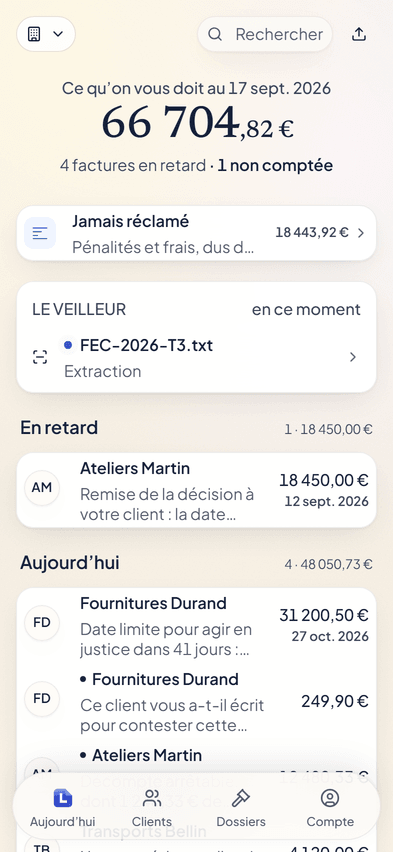
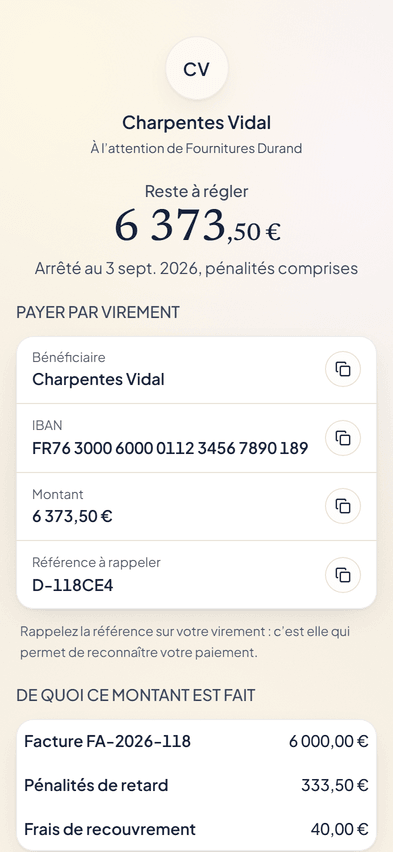
Penalties to the centThe penalties and costs due on each invoice, detailed period by period.
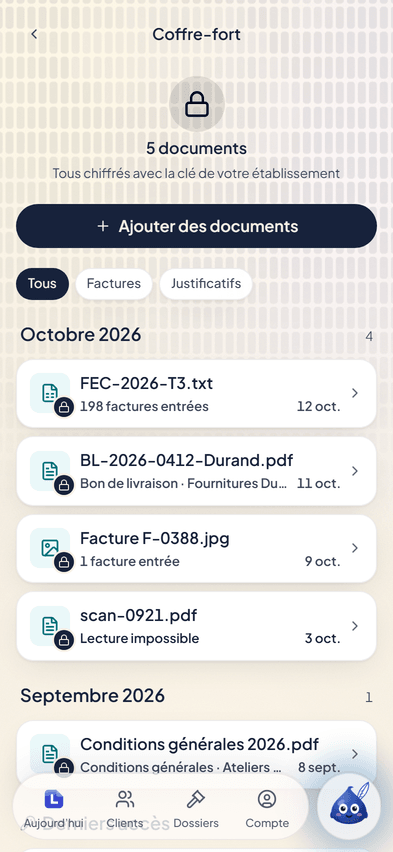
The vaultEvery document is sealed on arrival, and every opening is logged.
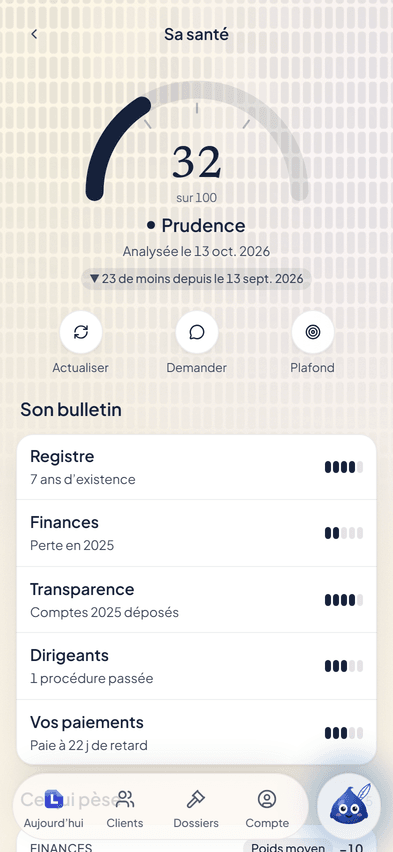
The health of your clientsA score out of one hundred, and each of the facts that move it, at its source.
The payment pageYour client pays by bank transfer, into your account, from a page in your name.
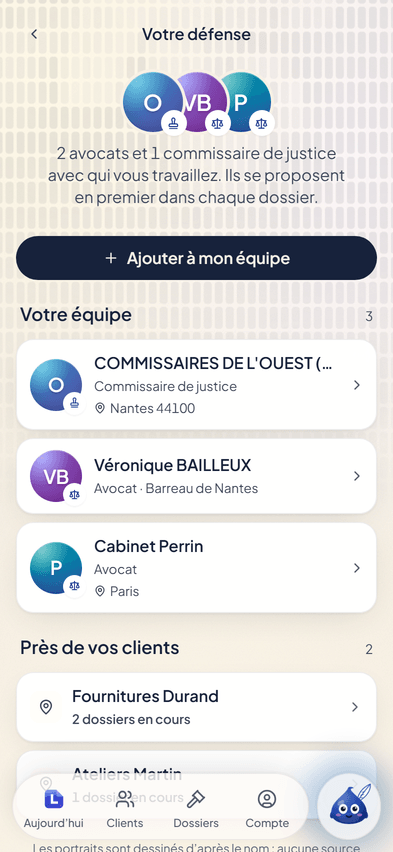
Your defenceThe lawyers and bailiffs (commissaires de justice) practising near your client, their contact details, and the case file ready to hand over to them.
Unpaid invoices between traders: the new procedure without a judge
A recent procedure allows an undisputed invoice between traders to be recovered through a commissaire de justice (court bailiff), without a hearing. Conditions, steps and limits.
What changesWithout a hearingfor an undisputed invoice
Upload an export or connect your software: you see what you are owed within minutes. 30-day trial, €0 today, no commitment.
Until now, getting an enforceable title to make a client pay almost always meant going through a judge: an order for payment, or a summons. A recent law opens another route, designed for the most common case between businesses: an invoice that nobody disputes, but that nobody pays.
It has a rather long name, the "procedure for recovering undisputed commercial claims". Here is what it allows, under what conditions, and what is not yet known.
What changes
The text is recent (article L126-1 du code des procédures civiles d’exécution, créé par la loi n° 2026-307 du 23 avril 2026). Its idea is simple: when your client does not dispute the invoice, a commissaire de justice (a court-appointed enforcement officer) can record that silence, and that record can become a title, with no hearing and no judge.
The procedure is new. At the time of writing, no court decision has yet clarified how it should be read.
The four conditions
The invoice must meet four conditions, all at the same time.
1
Established
Its existence is not in doubt: the service was performed, the goods were delivered, and your client
does not dispute it.
2
Quantified
Its amount is known and stated in figures: the amount of the invoice, not a sum yet to be assessed.
3
Due
It is payable now: its due date has passed.
4
Invoiced between traders
The text covers a claim that “has been invoiced between traders”.
The last condition needs some clarification: the text refers to the invoicing, not only to the people involved. Two traders may exchange an invoice that has nothing to do with their trade. Knowing that your client is a commercial company is therefore not enough, on its own, to settle the question.
May fall within the procedure
An overdue invoice between two traders, for their business activity
A clear amount, that of the invoice
A client who disputes neither the service nor the price
Does not fall within it
An invoice that your client disputes
An invoice that is not yet due
An invoice addressed to an individual
A sum that has to be assessed, such as damages
How it works
1
The formal demand for paymentthe starting point
A commissaire de justice serves your client with a formal demand for payment (commandement de payer): an official
document ordering them to pay the sum.
2
The period to respondfor 1 mois
Your client has this period to pay or to dispute the claim (article L126-2 du code des procédures civiles d’exécution).
It runs from the day the demand is served on them, not from the day it is drawn up.
3
If they dispute it
The procedure stops. The invoice becomes a disagreement again, to be settled by other means.
4
If they say nothingat the earliest 8 days after the end of the period
The commissaire de justice draws up a record of non-contestation (article L126-3 du code des procédures civiles d’exécution).
The two periods are added together: they do not overlap.
5
The title
This record, once endorsed with the enforcement formula, then allows enforcement measures to be taken to make
your client pay, like any title.
What is not yet known
Two points remain open at the time of writing.
The fee. The decree that is to set what this procedure costs with a commissaire de justice
has not been published. Until it is, its exact cost cannot be known.
How the text is read. No decision has yet said how to understand, for example, the
“invoicing between traders”. A commissaire de justice or a lawyer can tell you where
practice currently stands.
And the order for payment?
It does not disappear. An order for payment goes through a judge, who issues an order without hearing your client; your client can then oppose it. The new procedure, for its part, involves a judge only if something goes wrong. The time limits for the order for payment have also changed recently, as explained in
our article on the order for payment.
Choosing one, the other, or neither remains your decision, and it is made with the commissaire de justice or the lawyer you choose.
What Letikette does
Letikette shows, invoice by invoice, what your dossier says about each of the four conditions: the due date, the amount, and whether any dispute is known. You are the one who assesses them. And when you hand the dossier to a professional, they receive organised invoices and an itemised statement of the amount due.
This article presents general rules on a recent text. It does not constitute legal advice: the decision to act, and how to do so, remain yours.