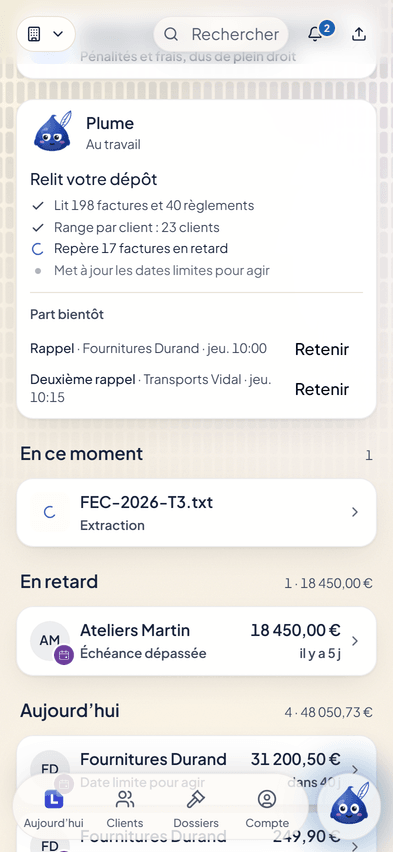
Reminders in your nameReminders and the formal letter go out in your name, and each one can be held back beforehand.
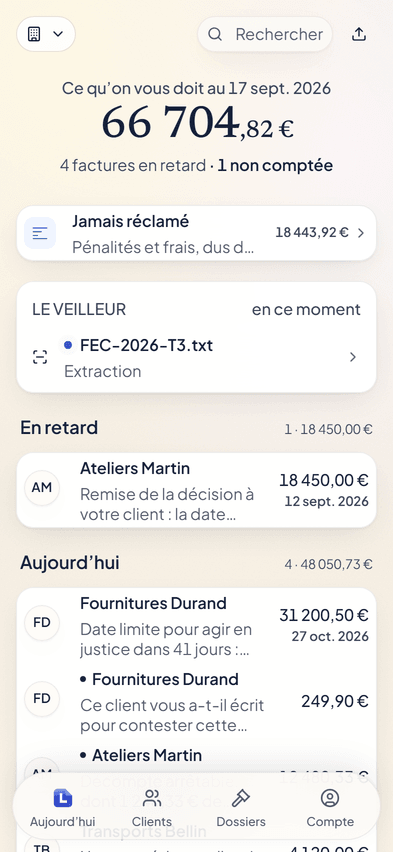
Penalties to the centThe penalties and costs due on each invoice, detailed period by period.
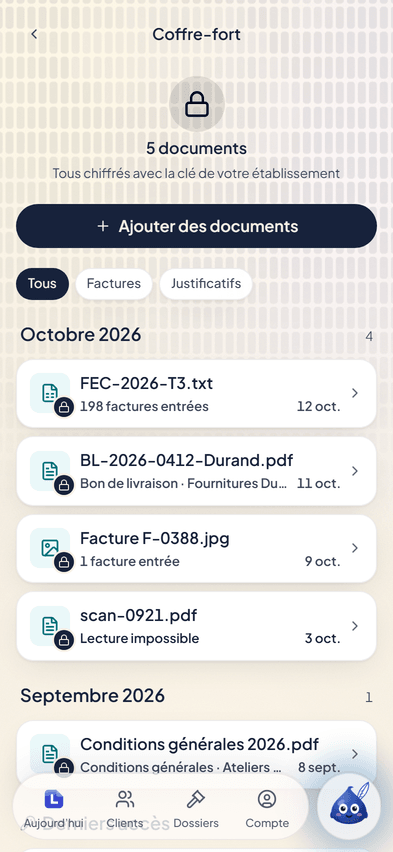
The vaultEvery document is sealed on arrival, and every opening is logged.
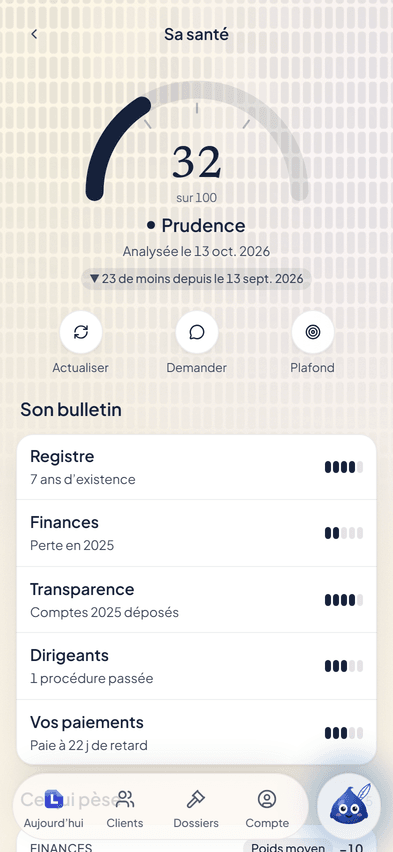
The health of your clientsA score out of one hundred, and each of the facts that move it, at its source.
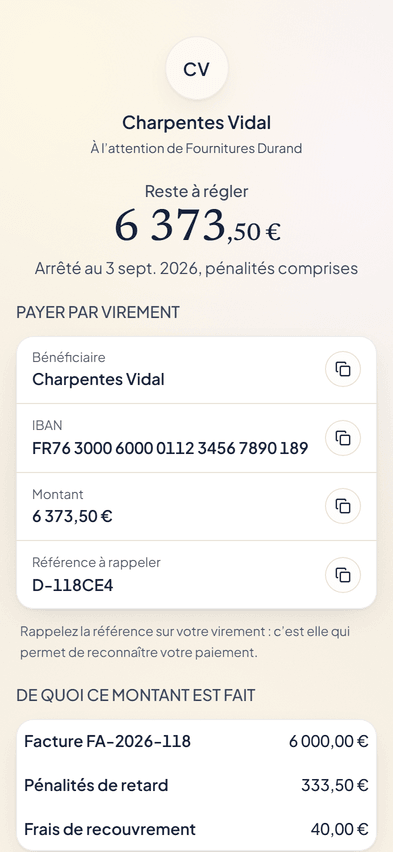
The payment pageYour client pays by bank transfer, into your account, from a page in your name.
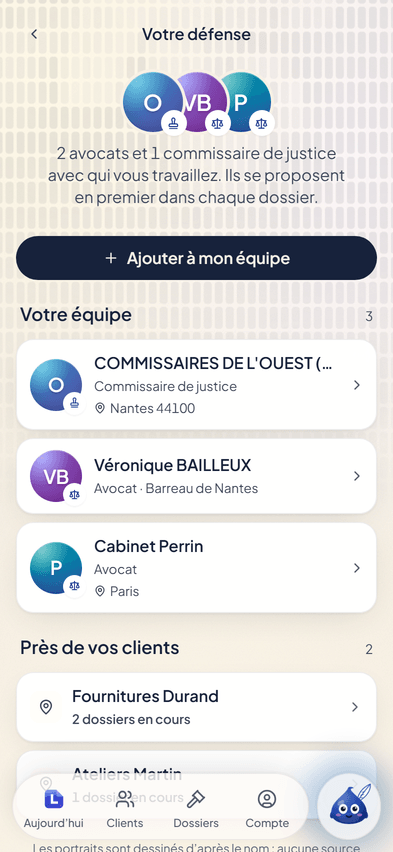
Your defenceThe lawyers and bailiffs (commissaires de justice) practising near your client, their contact details, and the case file ready to hand over to them.
Invoice paid late by a municipality: the penalties are still to be claimed
A local authority that pays your invoice late owes you penalties and costs, payable separately. What to do when they do not arrive, and what the law provides.
The time limit30 daysfor a local authority to pay you
Upload an export or connect your software: you see what you are owed within minutes. 30-day trial, €0 today, no commitment.
The invoice was paid in the end. It was six weeks late, but the money arrived, and the town hall remains a good client. For most suppliers, that is where the matter ends. Yet the delay created sums that have not been paid, and they will not pay themselves.
Late payment by local authorities, in figures
A municipality, a département or a region has
30 days to pay (articles L2192-10, R2192-10, R2192-11 et R2192-12 du code de la commande publique).
According to the
2025 report of the Observatoire des délais de paiement,
local authorities in mainland France pay in 18.9 days on average, but 15% of them exceed
that deadline. The average hides wide differences from one authority to another.
What the delay gives rise to
From the day after the payment deadline, late payment triggers penalties, which the law calls
"intérêts moratoires" (interest for late payment), due "as of right and without any further formality". It also entitles the supplier to a
fixed recovery fee of €40
(articles L2192-13 et L2192-14 du code de la commande publique).
Their rate is the ECB rate plus huit points, which gives 10,40 % a year for a
delay that starts this half-year, and it stays the same throughout the delay
(article R2192-31 du code de la commande publique).
Take a sample signage company, whose invoice of €4,180 to a municipality fell
due on 8 May and was paid on 22 June.
An invoice of €4,180, due on 8 May 2026What it is worth on 22 June 2026, with no payment in the meantime.
Calculated by the Letikette engine, on a 365-day basis. Each line can be checked with a calculator: amount × rate × days ÷ 365. Days are counted from the due date included to the cut-off date excluded: the same total as from the day after the due date to the cut-off date included.
Paid separately, within a set period
These sums are not settled with the invoice. The French Public Procurement Code (Code de la commande publique) provides that they are
paid within the 45 days following the payment
of the invoice (article R2192-36 du code de la commande publique).
If nothing arrives within that period, the sums do not disappear: they remain due, and
can be claimed.
Requesting them in writing
The first step is a written request addressed to the local authority: the invoice, its due date, the
payment date, the calculation of the penalties and the amount of the fees. A clear document that can be checked
line by line is dealt with faster than a call to the accounts department.
A written request has another effect, specific to public buyers: it interrupts the period
beyond which these sums might no longer be claimed (article 2 de la loi n° 68-1250 du 31 décembre 1968).
This is the opposite of the rule between businesses, where a simple letter interrupts nothing.
And if the local authority does not pay
The law has provided for this case. When the penalties and fees have not been ordered for payment within the period set
after the invoice is paid, the prefect, once the creditor has reported the matter, sends the local authority a
request to issue the payment order, then issues it themselves if the authority does not
act on it (article L1612-18 du code général des collectivités territoriales ; article L6145-5 du code de la santé publique). For a public hospital, it is the director of the regional
health agency who plays this role.
Reporting the matter is an administrative step, not legal proceedings. It is for you to
decide whether your relationship with this client justifies it.
What Letikette does
Letikette identifies the invoices of your public-sector clients that were paid late, calculates for each one
the penalties at the public procurement rate and the fees, and prepares the payment request in
your name. It then monitors these sums, along with the date beyond which they might no longer be
claimed.
This article presents general rules. It does not constitute legal advice: the decision
to act, and how to do so, remain yours.