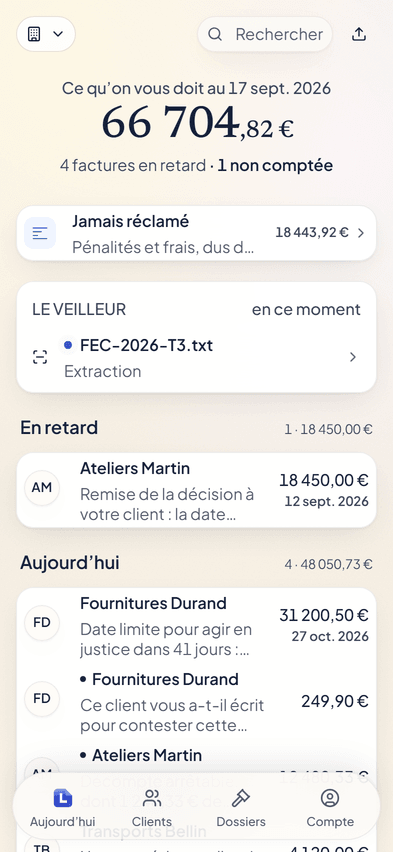
Reminders in your nameReminders and the formal letter go out in your name, and each one can be held back beforehand.
Penalties to the centThe penalties and costs due on each invoice, detailed period by period.
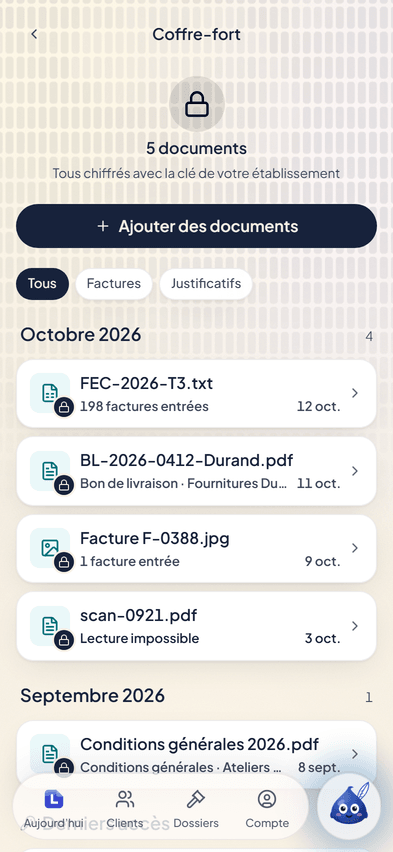
The vaultEvery document is sealed on arrival, and every opening is logged.
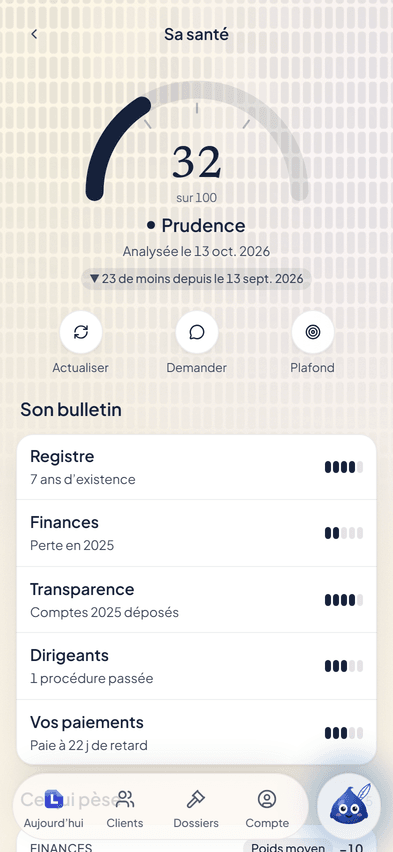
The health of your clientsA score out of one hundred, and each of the facts that move it, at its source.
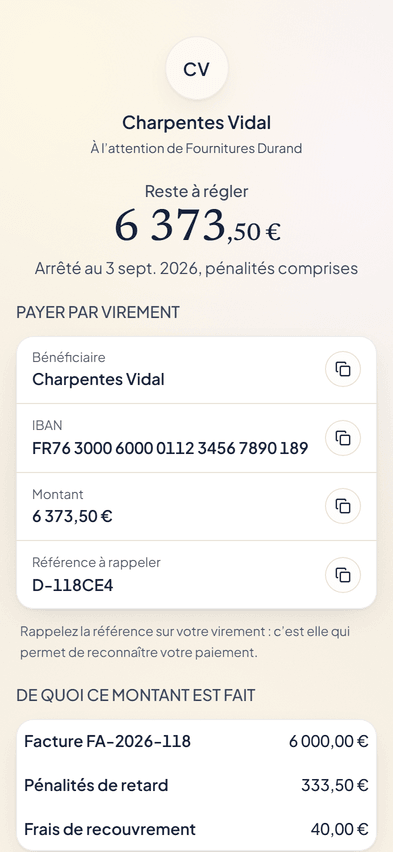
The payment pageYour client pays by bank transfer, into your account, from a page in your name.
Your defenceThe lawyers and bailiffs (commissaires de justice) practising near your client, their contact details, and the case file ready to hand over to them.
Upload an export or connect your software: you see what you are owed within minutes. 30-day trial, €0 today, no commitment.
L'injonction de payer is the procedure most often used for an unpaid invoice. It is quick, written, and needs no hearing. But it has a weak point that many people discover too late: the order obtained must be served on your client within a short deadline. After that deadline, it is worth nothing, and you have to start again.
This deadline has just been shortened. Here is what has changed, along with the procedure's other deadlines.
The payment order in a few lines
You, or your lawyer, send the court a request together with your invoices. The judge examines it without hearing your client. If the judge accepts it, they issue an order for payment (ordonnance portant injonction de payer).
Before the commercial court (tribunal de commerce) as before the judicial court (tribunal judiciaire), you are not required to have a lawyer as long as the claim does not exceed €10,000
(article 853 du code de procédure civile ; article 761 du code de procédure civile).
At this stage, the order has no force yet. It must first be officially brought to your client's attention by a commissaire de justice (a court enforcement officer): this is called service (signification).
The time limit that has changed
The order becomes ‘null and void’ (non avenue), meaning lost, if it is not served in time. This deadline is now 3 mois from the date of the order (article 1411 du code de procédure civile, modifié par le décret n° 2026-96 du 16 février 2026).
It used to be 6 mois
(article 1411 du code de procédure civile, version en vigueur du 1er mars 2022 au 1er avril 2026 [décret n° 2022-245 du 25 février 2022]). The new deadline applies to orders issued on or after 1 September 2026
(article 9 du décret n° 2026-96 du 16 février 2026).
Order issued before 1 September 20266 mois
Order issued on or after 1 September 20263 mois
The deadline for serving the order on your client, depending on the date of the order.
Two example orders, issued a few weeks apart, and their service deadlines:
Order of 20 August 2026, time limit of 6 moisto be given to your client by 22 February 2027 at the latest
Order of 15 September 2026, time limit of 3 moisto be given to your client by 15 December 2026 at the latest
Dates calculated by the Letikette deadline engine, rolled over to the next working day.
After service: the objection
Once the order has been served, your client can challenge it by lodging an objection (opposition). They have 1 mois from service to do so
(article 1416, alinéa 1, du code de procédure civile). If the service was not handed to them in person, this period runs from the first document handed to them in person, or from the first seizure.
If they lodge an objection, the case goes back before the court, and two deadlines then concern you directly.
1
At the commercial courtwithin 15 days
The court registry asks you, by registered letter, to pay a deposit for the costs of the objection. If the deposit is not paid within this deadline, the claim lapses (article 1425, alinéa 2, du code de procédure civile).
2
At the judicial courtwithin 15 days
Where representation by a lawyer is compulsory, you must appoint a lawyer within this deadline from the notification (article 1418 du code de procédure civile).
If no objection is lodged within the deadline, the order can be made enforceable, and your client can be required to pay.
Time limits at a glance
Step
Deadline
Runs from
Serve the order
3 mois
the date of the order
Lodge an objection (your client)
1 mois
service
Pay the costs deposit (commercial)
15 days
the registry's letter
Appoint a lawyer (judicial)
15 days
the notification
For an order issued before 1 September 2026, the service deadline remains 6 mois.
What Letikette does
When you upload an order to Letikette, the software reads the court and the order number, calculates the service deadline according to the date of the order, and monitors it. It prepares the request to the commissaire de justice you choose; they are the one who serves the order.
Whether or not to bring a payment order procedure remains your decision. It is made with the lawyer or commissaire de justice of your choice.
This article presents general rules. It does not constitute legal advice: the decision to act, and how to do so, remain yours.