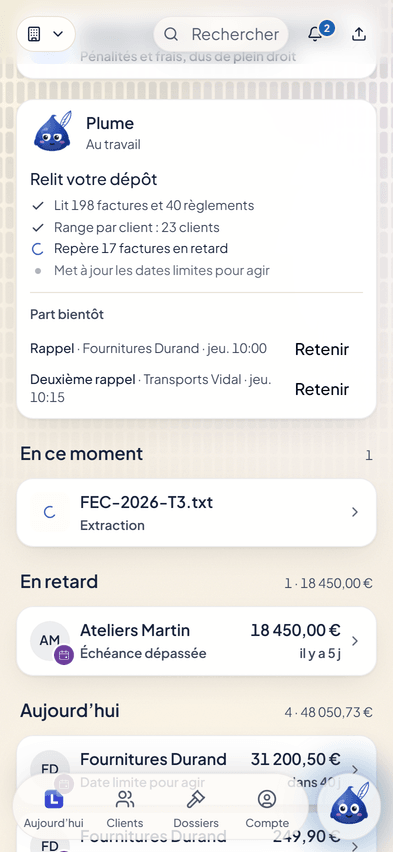
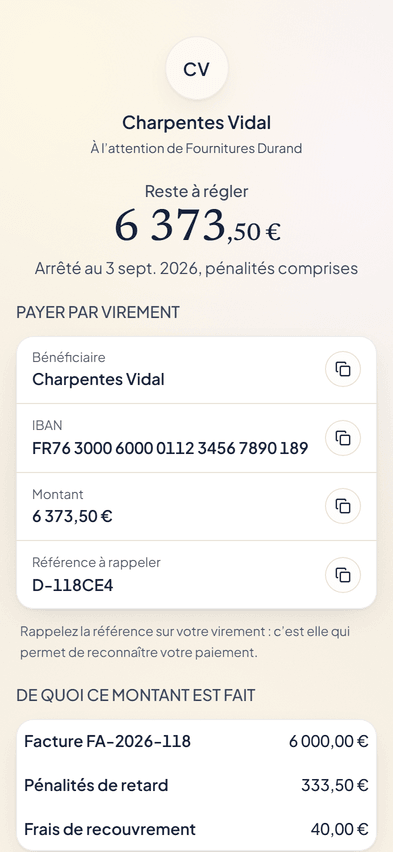
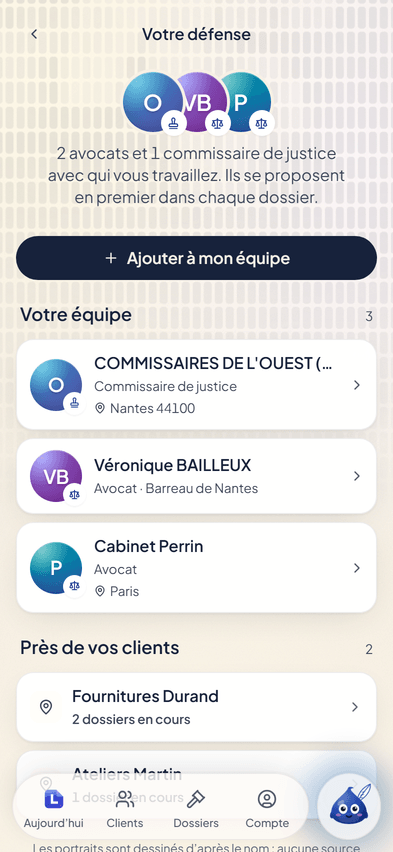
Reminders in your nameReminders and the formal letter go out in your name, and each one can be held back beforehand.
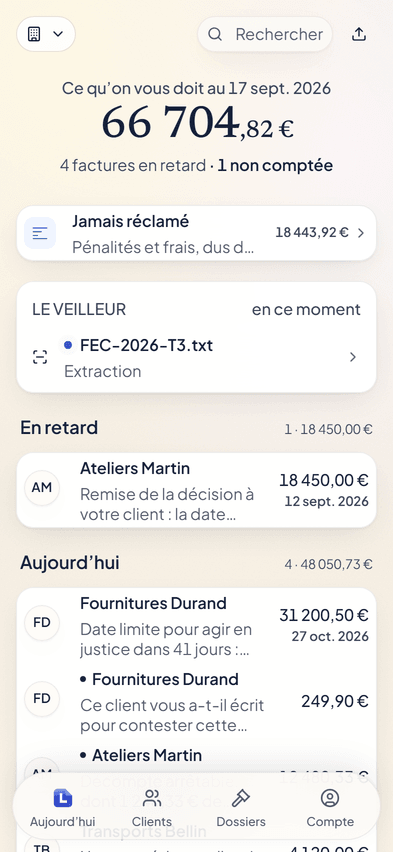
Penalties to the centThe penalties and costs due on each invoice, detailed period by period.
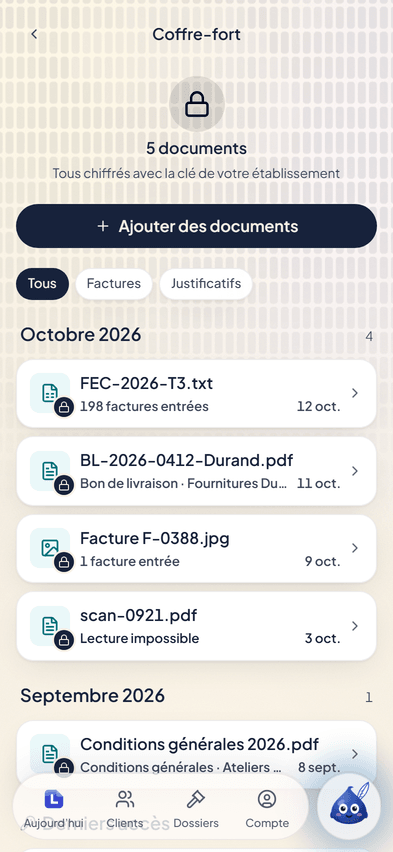
The vaultEvery document is sealed on arrival, and every opening is logged.
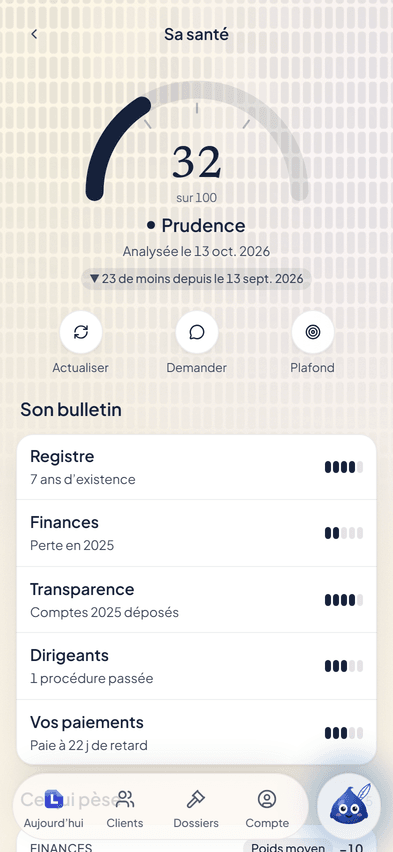
The health of your clientsA score out of one hundred, and each of the facts that move it, at its source.
The payment pageYour client pays by bank transfer, into your account, from a page in your name.
Your defenceThe lawyers and bailiffs (commissaires de justice) practising near your client, their contact details, and the case file ready to hand over to them.
Upload an export or connect your software: you see what you are owed within minutes. 30-day trial, €0 today, no commitment.
Si vous fournissez des hôpitaux publics, vous connaissez la situation : la facture part, le matériel est livré, et le paiement arrive deux mois et demi plus tard.
Correction: the output must be in English. Here is the translation.
If you supply public hospitals, you know the situation: the invoice goes out, the equipment is delivered, and payment arrives two and a half months later. You wait, because the hospital always ends up paying, and because you don't chase a hospital the way you would a private client.
What most suppliers don't realise is that this delay entitles them to sums that nobody will pay them unless they ask for them.
70 days, against a 50-day limit
The payment deadline for a public health establishment is set at
50 days, compared with 30 days for
the State and local authorities (articles L2192-10, R2192-10, R2192-11 et R2192-12 du code de la commande publique). A contract cannot provide for a longer period.
In practice, the
2025 report of the Observatoire des délais de paiement
measures an average of 70.2 days for public hospitals in mainland France in 2025, against 62.3
days a year earlier, and 71.3 days across the whole territory. It describes a ‘new and worrying deterioration’.
Penalties that accrue without any formality
The French Public Procurement Code is clear: from the day after the payment deadline, the delay ‘gives rise, as of right and without further formality, to late-payment interest’ (articles L2192-13 et L2192-14 du code de la commande publique). ‘Intérêts moratoires’ (late-payment interest) is the name the law gives to the late-payment penalties of a public buyer.
‘As of right and without further formality’ means that you do not have to do anything for them to be due: no reminder, no clause in the contract, no registered letter. And a clause by which you waived them would have no effect: ‘any waiver of payment of late-payment interest is deemed unwritten’.
A rate set once for the whole delay
The rate is the European Central Bank rate plus huit points, that is
10,40 % per year for a delay that begins this half-year
(article R2192-31 du code de la commande publique).
One particularity sets it apart from the rate between businesses: it is set only once, on the first day of the delay, and applies for its entire duration. A delay that begins in June keeps the first-half rate even if it lasts until December.
The penalties are calculated on the invoice amount including all taxes, less any retention provided for in the contract (article R2192-33 du code de la commande publique), from the day after the due date until the day payment is released (article R2192-32 du code de la commande publique).
And recovery costs
The delay also entitles you to a fixed indemnity for recovery costs, of
€40 (article D2192-35 du code de la commande publique), likewise ‘as of right and without further formality’.
An example
Take a sample supplier delivering medical equipment to a hospital. Its invoice of
€12,840 falls due on 9 July, at the end of the 50 days. The hospital
releases it for payment on 17 September, which matches the average delay recorded by the Observatory.
An invoice of €12,840, due on 9 July 2026What it is worth on 17 September 2026, with no payment in the meantime.
Calculated by the Letikette engine, on a 365-day basis. Each line can be checked with a calculator: amount × rate × days ÷ 365. Days are counted from the due date included to the cut-off date excluded: the same total as from the day after the due date to the cut-off date included.
On a single invoice, the sum remains modest. Over a year of deliveries, with one invoice a week that is systematically paid late, it no longer is.
They are paid after the invoice
The penalties and costs are not settled with the invoice: they must be paid within the
45 days following its release for payment
(article R2192-36 du code de la commande publique).
In practice, many hospitals never pay them of their own accord. For you, an invoice paid late is therefore not a closed matter: the sums attached to it remain due, and have to be requested. Not indefinitely: on our reading of the law, they may no longer be claimable after 4 ans, counted under rules specific to public buyers that we detail in another article.
What Letikette does
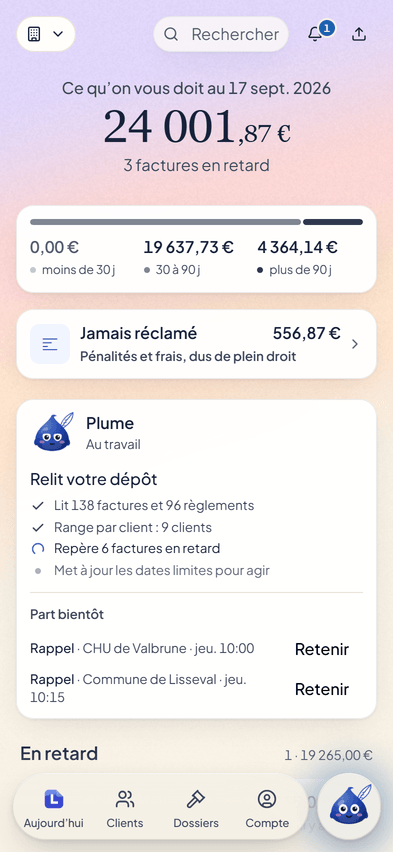
Letikette recognises a public-sector client from its SIREN number and applies the public procurement scale to each of its invoices, paid or unpaid. It calculates the penalties and costs invoice by invoice, and prepares the payment request in your name. You review it, and you decide whether to send it.
Letikette's Today screen for a hospital supplier: what its public-sector clients owe it, penalties and costs included.
This article presents general rules. It is not legal advice: the decision to act, and how to do so, remain yours.