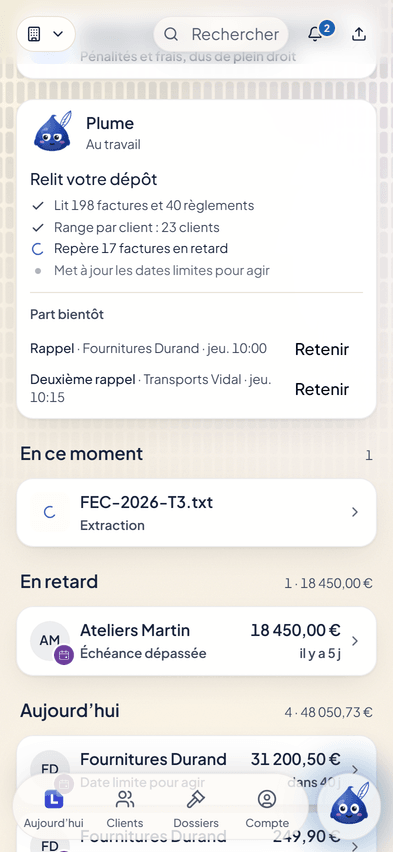
Reminders in your nameReminders and the formal letter go out in your name, and each one can be held back beforehand.
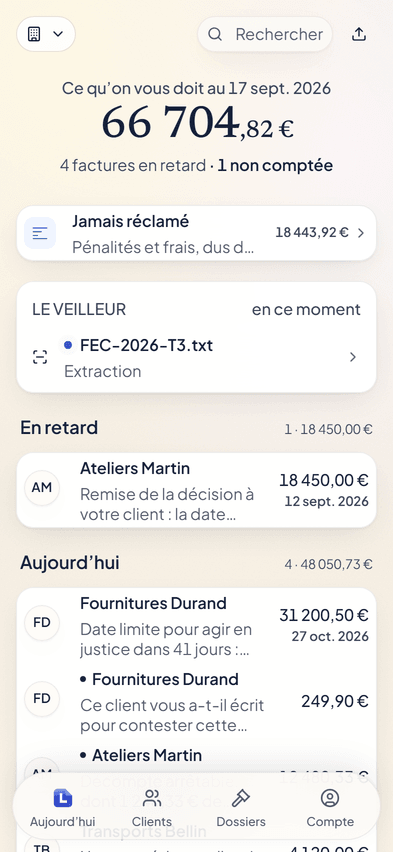
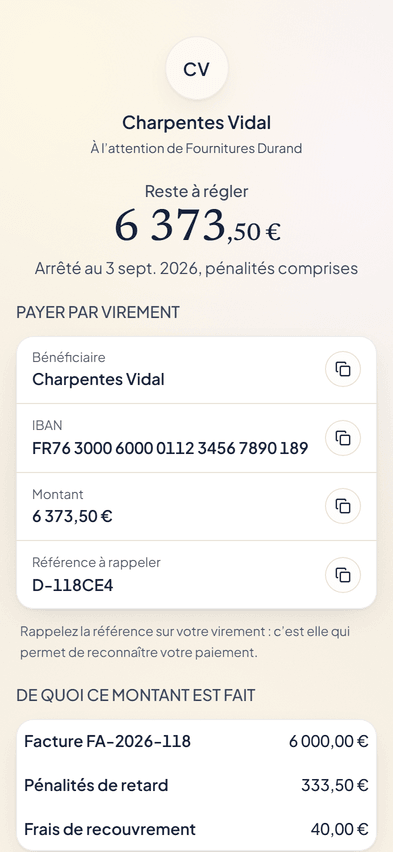
Penalties to the centThe penalties and costs due on each invoice, detailed period by period.
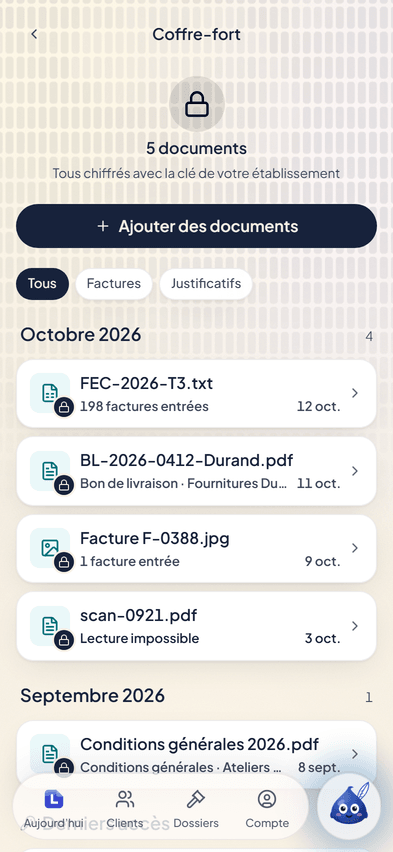
The vaultEvery document is sealed on arrival, and every opening is logged.
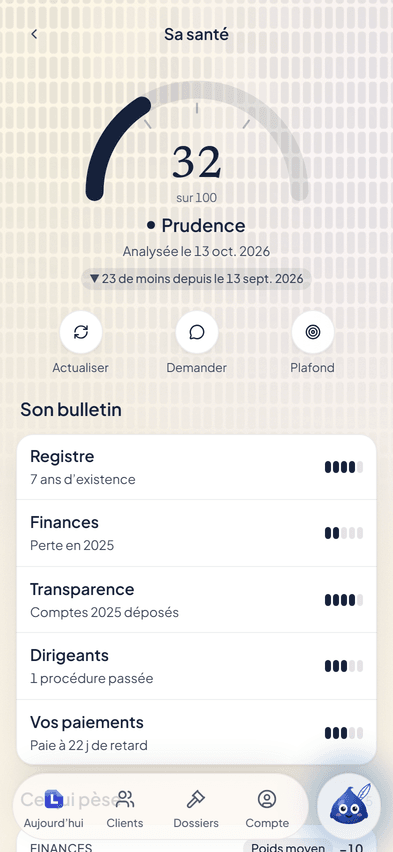
The health of your clientsA score out of one hundred, and each of the facts that move it, at its source.
The payment pageYour client pays by bank transfer, into your account, from a page in your name.
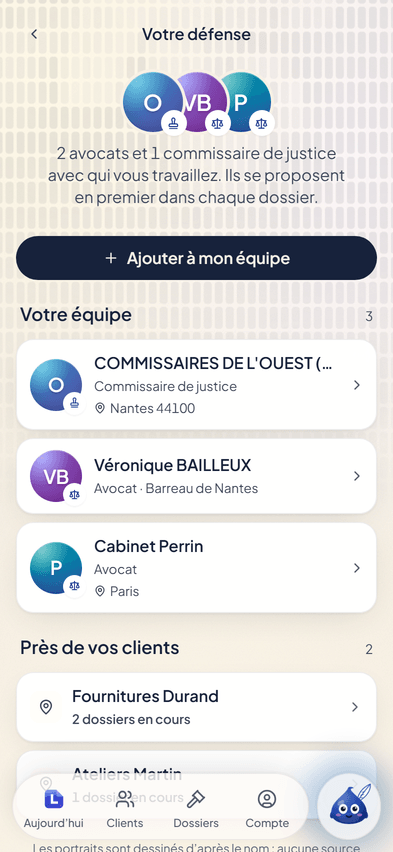
Your defenceThe lawyers and bailiffs (commissaires de justice) practising near your client, their contact details, and the case file ready to hand over to them.
Upload an export or connect your software: you see what you are owed within minutes. 30-day trial, €0 today, no commitment.
Building work is rarely invoiced in one go. A progress invoice each month, a down payment at the start, a final account at the end: a single client can receive ten invoices for the same project. And when that client pays each one a few weeks late, it owes you a good deal more than the invoice amounts.
A progress statement is an invoice
In law, a progress invoice for works is an invoice like any other: it has a due date, and it is paid on time or late. Between businesses, late payment has a price set by law.
‘Any professional in a situation of late payment is automatically liable’ for a fixed indemnity for recovery costs (article L441-10 II du code de commerce), of €40 (article D441-5 du code de commerce, version en vigueur depuis le 27 février 2021 [décret n° 2021-211, art. 3]). And the authorities apply it ‘to each invoice that has not been paid within the time allowed’ (Service-Public Entreprendre, fiche F23211 [lecture de l’administration]).
An example site
Take an example joinery firm fitting the joinery in a building for a property developer. The project lasts six months and is invoiced in six monthly progress invoices. The developer pays them all, but each one three to four weeks late.
The developer does not owe one indemnity for the project: it owes one for each progress invoice paid late.
Invoice 01+ €40
Invoice 02+ €40
Invoice 03+ €40
Invoice 04+ €40
Invoice 05+ €40
Invoice 06+ €40
6 invoices × €40€240
One client, several invoices paid late: recovery costs for each one.
These fees remain due even if all the progress invoices were eventually paid: the delay did happen. It is the sum most often overlooked in the building trade, because it appears on no bank statement.
Penalties on top
The fixed fees are added to the late-payment penalties; they do not replace them. Where the contract sets no rate, penalties run at the ECB rate plus dix points, which is 12,40 % per year this half-year (article L441-10 II du code de commerce), starting the day after the payment date shown on the invoice (article L441-10 II du code de commerce).
For a progress invoice of €18,450 due at the end of July and still unpaid in mid-September, here is what the law adds.
An invoice of €18,450, due on 31 July 2026What it is worth on 17 September 2026, with no payment in the meantime.
Calculated by the Letikette engine, on a 365-day basis. Each line can be checked with a calculator: amount × rate × days ÷ 365. Days are counted from the due date included to the cut-off date excluded: the same total as from the day after the due date to the cut-off date included.
Without a contract clause
Many tradespeople think these penalties must have been written into the quote or the general terms before they can be claimed. Between businesses, that is not the case: penalties are ‘payable without the need for a reminder’ (article L441-10 II du code de commerce), and the indemnity is due automatically. The contract may set a different rate, provided it is not below the legal minimum of 8,25 % (article L441-10 II du code de commerce).
What is not covered
Two separate cases, so that you do not apply the wrong rule.
A private individual as client. The €40 fee and the increased rate apply to late payment between businesses. For works carried out for a private individual, the rule is different, and so is the time limit for taking legal action: 2 ans instead of 5 ans.
A client in collective insolvency proceedings. When safeguard, recovery or liquidation proceedings prohibit payment on the due date, the indemnities cannot be claimed (article L441-10 II, dernière phrase, du code de commerce).
To claim, or not
Claiming these sums from a principal you have worked with for years is a commercial decision, and it is yours to make. Knowing about them does change the conversation, though: when a developer asks for a concession on the final account, knowing what its late payments have cost you gives you something to point to.
What Letikette does
Letikette reads your progress invoices and your invoices, identifies those that were paid late, even if they have since been settled, and calculates the fees and penalties for each one to the cent. You see, client by client, what has never been claimed, and you decide what to do with it.
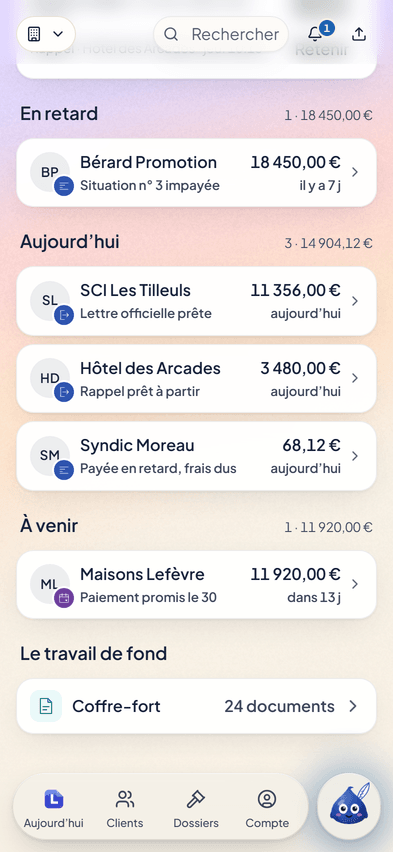
Letikette cards for a joinery firm: an unpaid progress invoice, a formal letter ready to send, an invoice paid late and its fees.
This article presents general rules. It does not constitute legal advice: the decision to take action, and how to do so, remain yours.