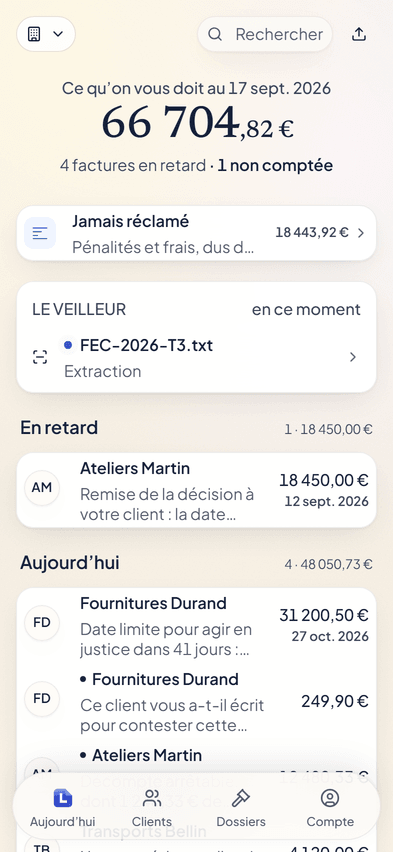
Reminders in your nameReminders and the formal letter go out in your name, and each one can be held back beforehand.
Penalties to the centThe penalties and costs due on each invoice, detailed period by period.
The vaultEvery document is sealed on arrival, and every opening is logged.
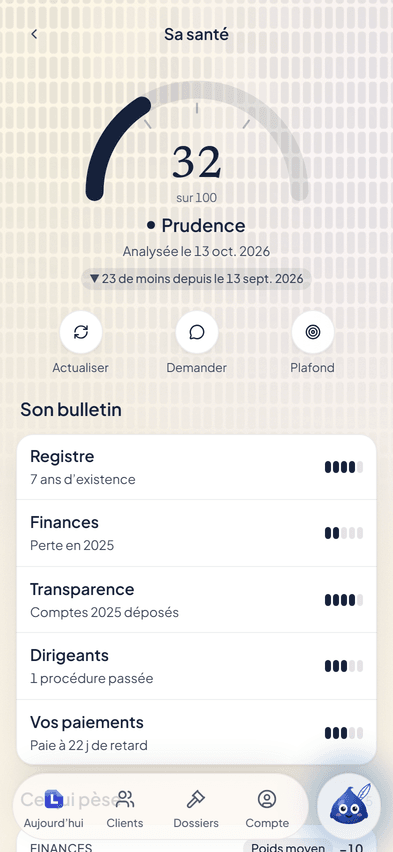
The health of your clientsA score out of one hundred, and each of the facts that move it, at its source.
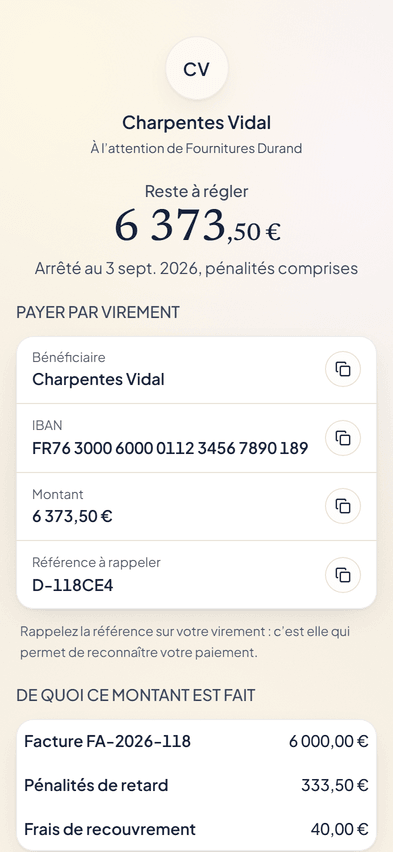
The payment pageYour client pays by bank transfer, into your account, from a page in your name.
Your defenceThe lawyers and bailiffs (commissaires de justice) practising near your client, their contact details, and the case file ready to hand over to them.
Upload an export or connect your software: you see what you are owed within minutes. 30-day trial, €0 today, no commitment.
Le 24 septembre 2026 → On 24 September 2026, the Banque de France published the
2025 report of the Observatoire des délais de paiement (Payment Times Observatory).
It is the reference document on how businesses, the State and hospitals settle their
invoices. We have read it for you, with one question in mind: what does it change for a business
that invoices other businesses?
13.4 days late on average
The key figure is this: at the end of 2025, the average payment delay in France stood at 13.4 days. It is
slightly down on December 2024, but remains above its long-term average of 12.2 days, and above the
European average of 13.3 days.
In spring 2025, for the first time, the French delay even exceeded Europe's:
14.1 days against 14.0. France, long a model performer, no longer is.
An average delay of two weeks hides huge differences. Some businesses pay on time;
others pay one or two months late. According to
Altares,
which measures businesses' payment behaviour, 47% of French businesses paid without delay in the
last quarter of 2025, and 8.6% paid more than thirty days late.
€13 billion missing from SMEs
The report puts a figure on what these delays cost. In 2024, without payments beyond the statutory deadlines,
SMEs and micro-enterprises ‘would have had €13 billion of additional cash flow’:
€9 billion for SMEs and €4 billion for micro-enterprises.
The worst payers are not the small businesses. Fewer than one large company in two meets
the 60 days deadline: delays travel down the chain, from the large
principal client to the SME working for it.
Who pays latest
Altares' measurements break down, sector by sector, how late businesses
pay their own suppliers, in the last quarter of 2025.
Business services: 18.4 days, one of the highest levels.
Transport and logistics: 16 days.
Trade: 12.3 days.
Manufacturing: 11.2 days.
Construction: 10.8 days.
This ranking shows who pays late, not who is paid late. It should therefore be read from the side of your clients:
if you work for service or transport companies, they are among those
that settle latest. And a tradesperson paid by a developer or a property manager is subject to the terms of the
clients who commission their work, not those of their own sector.
And public buyers
The report also tracks the State, local authorities and hospitals, which have their own deadlines.
The State paid in 15.9 days on average in 2025, against 14.1 days in 2024.
Local authorities in mainland France pay in 18.9 days, but 15% of them exceed the
permitted 30 days.
Public hospitals pay in 70.2 days in mainland France and 71.3 days across the whole territory,
against a permitted term of 50 days. The report speaks of a ‘new
and worrying deterioration’.
If you supply hospitals, you have probably noticed. What many suppliers
do not know is that this delay entitles them to penalties, calculated at a rate set by the
code de la commande publique (the French public procurement code). We come back to this in a dedicated article.
What two weeks of delay are worth
An average delay of 13 days seems harmless. It is not, because the law attaches two
sums to it, due automatically between professionals.
Late-payment penalties, at the ECB rate plus dix points, i.e.
12,40 % per year this half-year (article L441-10 II du code de commerce).
A fixed recovery fee of €40 per invoice paid late
(article D441-5 du code de commerce, version en vigueur depuis le 27 février 2021 [décret n° 2021-211, art. 3]).
Take an example invoice of €4,800, due on 30 June and paid on 14 July, i.e. two
weeks later.
An invoice of €4,800, due on 30 June 2026What it is worth on 14 July 2026, with no payment in the meantime.
Calculated by the Letikette engine, on a 365-day basis. Each line can be checked with a calculator: amount × rate × days ÷ 365. Days are counted from the due date included to the cut-off date excluded: the same total as from the day after the due date to the cut-off date included.
On a short delay, the penalties come to a few euros. The recovery costs, however, amount to
€40 from the first day. Multiplied by the number of invoices paid late
in the year, they add up to a significant sum.
What Letikette does
Letikette reads your invoices and your payments, identifies those that were paid late, even
if they have since been settled, and calculates the penalties and recovery costs for each one, to the cent. You
see what your clients owe you, and you decide what you claim.
This article presents public data and general rules. It does not constitute legal
advice: the decision to act, and how to do so, remain yours.